Every Opportunity Cost choice you make has a price tag that never shows up on a receipt. When you spend $200 on concert tickets, the real cost isn’t only $200. It’s everything else that $200 could have done. That hidden price is called opportunity cost, and once you notice it, money decisions get a lot clearer.
This guide explains opportunity cost in plain English, shows you the simple formula, and walks through seven everyday examples. You’ll also learn how to use the idea without overthinking every purchase.
What Is Opportunity Cost?
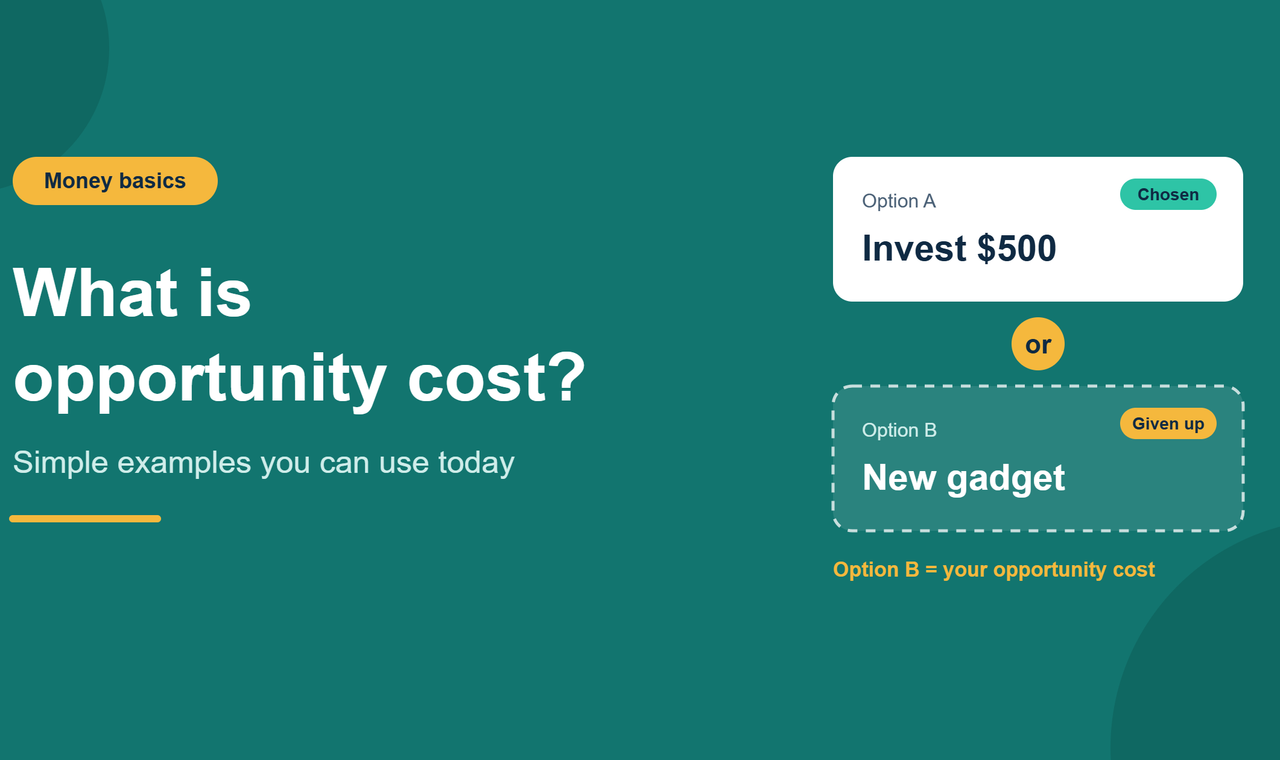
Opportunity cost is the value of the next-best option you give up when you make a choice. Not every option you skipped. Just the best one you passed on.
Say you have $1,000 and two choices: fix your car or take a weekend trip. If you fix the car, the trip is your opportunity cost. If you take the trip, the repair is.
Money, time, and energy are limited, so choosing one thing means not choosing another. Economists call this scarcity. It’s simply how scarcity shows up in daily life.
And it isn’t only about money. An hour spent scrolling is an hour you can’t spend sleeping, exercising, or earning. For a deeper definition, see Investopedia’s guide to the concept.
Explicit vs. Implicit Costs
Explicit costs are out-of-pocket: you hand over cash. Implicit costs are what you give up without writing a check, like income you didn’t earn. This idea mostly lives in the implicit category, which is why people miss it.
The Opportunity Cost Formula
Here’s a simple way to put numbers on it:
Opportunity cost = return on the option you gave up − return on the option you chose
A positive result means the path you skipped would have paid more. It’s a rough tool, because it works best when both options have dollar values. Plenty of choices include things money can’t capture, like health, family time, or peace of mind. Those count too.
7 Simple Opportunity Cost Examples
These examples use hypothetical numbers to show the idea. Real rates and returns vary and aren’t guaranteed.
1. Paying Down Debt vs. Investing
You have an extra $2,000. Your credit card charges 24% APR. You could pay down the balance or invest the money.
Paying the card saves roughly $480 in interest over a year (simplified, ignoring compounding). Investing at a hypothetical 7% return would earn about $140. So the opportunity cost of investing here is roughly $340.
There’s another difference. The savings from paying debt are certain. The investment return isn’t.
2. Buying Something Now vs. Investing the Money
Suppose you’re eyeing a $5,000 upgrade you want but don’t need. If you invested that $5,000 at a hypothetical 7% a year for 10 years, it would grow to roughly $9,800. The opportunity cost of the purchase is that growth, about $4,800 on top of your original $5,000.
The Rule of 72 gives a quick check. Divide 72 by 7 and you get about 10, so money growing at 7% roughly doubles in a decade.
That doesn’t make the purchase wrong. It makes it a conscious choice. Our guide on needs vs wants can help you decide which spending deserves a yes.
3. Keeping Cash in a Low-Rate Account
You keep $10,000 in an account paying 0.5%, which earns $50 a year. A high-yield savings account paying a hypothetical 4% would earn $400. The opportunity cost is about $350 a year.
Many online banks and neobanks pay higher savings rates than traditional branches, as our explainer on what a neobank is shows. Whichever you choose, confirm the money sits at an FDIC-insured bank. The FDIC explains how deposit insurance works on its site.
4. Spending Your Time: Side Gig vs. a Free Afternoon
A weekend freelance gig pays $30 an hour for four hours. If you skip it to relax, you give up $120. That’s the price of the free afternoon.
Rest has real value, so it may be worth it. The point is to see the trade clearly instead of pretending it’s free.
5. Going to College or a Training Program
School costs tuition, but it also costs the paycheck you could have earned by working instead. If you’d earn $35,000 a year at a full-time job, a two-year program means about $70,000 in forgone income on top of tuition.
Many people still choose education because the long-term career benefits can outweigh that cost. The key is counting the whole bill.
6. Renting vs. Buying a Home
Buying usually means tying up a down payment. If that’s $50,000, you can’t invest it elsewhere. That’s one cost of buying.
Renting has its own: you don’t build equity. Neither option automatically wins. The right pick depends on your timeline, local prices, and finances.
7. Skipping Your 401(k) Match
Say your employer matches 50% of what you contribute, up to 6% of pay, and you earn $60,000. Contributing 6% means $3,600 from you and $1,800 from your employer.
Contribute nothing, and you leave that $1,800 on the table before any growth. Match formulas differ by employer, so check your plan documents. The IRS offers an overview of 401(k) plans.
Opportunity Cost vs. Sunk Cost
People often mix these up. They sound similar but point in opposite directions.
| Feature | Opportunity cost | Sunk cost |
|---|---|---|
| What it is | Value of the best option you give up | Money or time already spent that you can’t recover |
| Direction | Looks forward | Looks backward |
| Should it guide your decision? | Yes | No |
| Example | Choosing a vacation over investing $3,000 | Keeping a nonrefundable ticket you no longer want to use |
The sunk cost trap catches many investors: staying in a losing investment because you’ve already put money in. That money is gone either way. The smarter question is what you’d choose today, starting fresh.
Benefits and Limits of Thinking This Way
Benefits
- Makes hidden costs visible
- Helps you prioritize limited money and time
- Lets you compare options fairly
Limits
- Hard to measure when outcomes are uncertain
- Can lead to analysis paralysis on small decisions
- Misleads you if you only count dollars and ignore well-being
How to Weigh Choices in Everyday Life
- List your real options. You need at least two.
- Find the best alternative. Only the top runner-up counts.
- Put numbers on it. Use dollars, hours, or both.
- Weigh the risk. A guaranteed return and a hoped-for return aren’t equal. Our breakdown of risk tolerance can help you judge how much uncertainty you’re comfortable with.
- Decide and move on. A good-enough decision beats endless comparing.
Common Opportunity Cost Mistakes
- Ignoring time. Hours have value too.
- Counting every alternative. Only the best skipped option matters.
- Mixing it up with sunk costs. Past spending shouldn’t steer future choices.
- Treating hoped-for returns as guaranteed. Investments can lose money.
- Overanalyzing tiny choices. Save the deep math for big decisions.
- Forgetting non-money value. Health, family, and rest count.
Frequently Asked Questions
What is opportunity cost in simple terms?
It’s what you give up when you choose one option over another. Specifically, it’s the value of the best alternative you didn’t pick.
Is it only about money?
No. It also applies to time, energy, and attention. Spending a Saturday on one project means you can’t spend it on another.
What’s a quick real-life example?
Spending $50 on a dinner out means that $50 can’t go toward a credit card balance, where it would have saved interest.
Does every decision have a hidden cost?
Whenever you have limited resources and more than one option, yes. Some costs are tiny, and some are large enough to change your plans.
Is opportunity cost the same as a trade-off?
They’re closely related. A trade-off is the act of giving up one thing to get another. The cost is the value of what you gave up.
Can the cost of a choice ever be zero?
Rarely. It could be close to zero if a resource has no other use, such as time you couldn’t have spent on anything productive anyway.
Final Thoughts on Opportunity Cost
Opportunity cost isn’t about guilt or never spending. It’s about making choices with your eyes open. Every yes to one thing is a no to something else, and knowing what that something is makes your decisions stronger.
Here’s your next step. Think of one money decision you’re facing this month. Write down the best alternative you’d give up and put a dollar or hour figure on it. If it still feels worth it, go ahead. If it doesn’t, you just saved yourself a regret. Then read our guides on needs vs wants and risk tolerance to sharpen your next decision.
Disclaimer: This article is for educational purposes only and is not personalized financial, investment, legal, or tax advice. All numbers are hypothetical examples. Consult a qualified professional before making financial decisions.