Online Banking Fraud Your phone buzzes with a text: “Suspicious activity on your account. Reply YES or NO.” You tap without thinking. Five minutes later, someone calls claiming to be your bank’s fraud department. . They sound calm and professional. They already know your name.
That’s how a lot of online banking fraud works. It rarely looks like a hacker in a dark room. It looks like a normal message at a bad moment.
The good news is that you can become a much harder target. This guide explains how online banking fraud happens, the warning signs to watch for, and seven simple ways to protect your accounts. You’ll also learn what to do in the first hour if something goes wrong.
What Is Online Banking Fraud?
Online banking fraud is any scheme that uses digital channels to steal your money or account information. Some of it involves your bank’s website or app. Much of it happens through texts, emails, phone calls, and social media messages that trick you into handing over access.
There are two broad types:
- Unauthorized fraud: Someone gets your login or card details and moves money without your permission.
- Authorized fraud (scams): You’re tricked into sending the money yourself, often because the request seems real.
The difference matters when you try to recover your money, as you’ll see below. Investopedia’s overview of phishing explains one of the most common tactics in detail.
Common Types of Online Banking Fraud
Criminals use many tricks, but most fall into a few patterns. Here’s a quick guide.
| Type | How It Works | Warning Sign |
|---|---|---|
| Phishing | Fake emails, texts, or websites mimic your bank to steal your login | Urgent language, odd links, requests for your password |
| Smishing and vishing | Scam texts or phone calls, sometimes with a spoofed bank number | An unexpected call asking for codes or PINs |
| Account takeover | A criminal logs in with stolen credentials and changes your settings | Password-reset emails you didn’t request |
| Payment app scams | You’re pressured to send money through a payment app | Demands to act fast or move money to a “safe account” |
| Malware and fake apps | Malicious software or copycat apps capture your data | Apps from outside official stores, strange pop-ups |
| SIM swap | A criminal takes over your phone number to intercept codes | Sudden loss of cell service |
Be very suspicious of anyone who asks you to move money to a “safe account.” That’s a classic scam script. A real problem with your account can be handled through the official channels on your card or in your app.
Warning Signs of Online Banking Fraud
Catching online banking fraud early limits the damage. Watch for these signs:
- Small, unfamiliar charges. Thieves often test an account with tiny amounts first.
- Password-reset or login alerts you didn’t trigger
- Notifications about a new device, payee, or changed contact information
- Being locked out of your account unexpectedly
- Calls or texts asking you to read back a one-time code
- Pressure to act immediately, or to keep a request secret
- Mail or alerts about accounts or loans you never opened
Any one of these deserves a closer look. Two or three together mean it’s time to call your bank.
7 Simple Ways to Protect Yourself From Online Banking Fraud
These seven habits do most of the work. You can set up the first five in under an hour.
1. Use Strong, Unique Passwords
Reusing a password is one of the easiest ways to get hacked. If one site leaks it, criminals try it everywhere else, including your bank. Use a long, unique password for every financial account. A password manager makes that practical, since you only have to remember one master password.
2. Turn On Multi-Factor Authentication
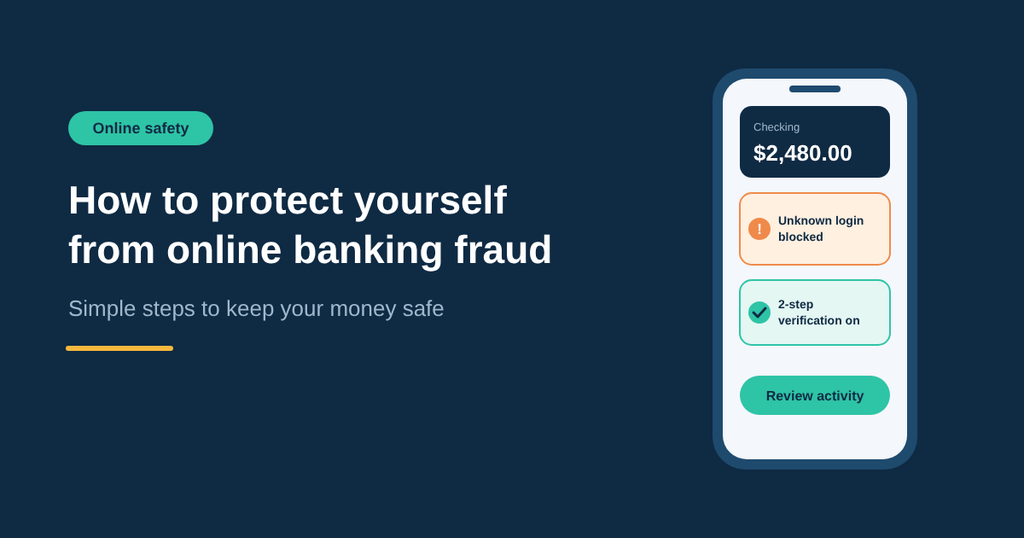
Multi-factor authentication (MFA) adds a second step after your password, like a code or a prompt on your phone. Even if a thief steals your password, they’re blocked without that second factor.
Where your bank offers options, an authenticator app or a passkey is generally stronger than a text message code, because texts can be intercepted through SIM swapping. Any MFA is better than none.
3. Never Share One-Time Codes or PINs
A one-time code is for you alone. Anyone who asks you to read it back to them, even someone who sounds like your bank, is likely trying to get into your account. Hang up and call back using the number on your card.
4. Go Directly to Your Bank
Don’t click links in messages that claim to be from your bank. Open the official app, or type the website address yourself. If a call or text worries you, use the phone number printed on your debit card or statement, not the number that contacted you.
5. Turn On Account Alerts
Set up alerts for transactions over a certain amount, logins from new devices, password changes, and new payees. Alerts turn a slow leak into an instant warning.
Alerts work best when you know your normal patterns. Tracking your spending habits makes odd charges stand out, and our guide on needs vs wants is a good place to start.
6. Secure Your Devices and Networks
Keep your phone and computer updated, since updates often patch security holes. Use a screen lock. Download banking apps only from official app stores. Avoid doing your banking on public Wi-Fi. If you must, use your cellular connection instead.
7. Check Your Accounts and Credit Regularly
Look over your transactions at least weekly. You can also get free credit reports at AnnualCreditReport.com to spot accounts you didn’t open.
For extra protection, consider a credit freeze, which is free and blocks most lenders from opening new credit in your name until you lift it. A fraud alert is a lighter option that asks lenders to verify your identity first. Both are placed through the credit bureaus.
Digital Banks, Fintech Apps, and FDIC Insurance
Digital-only banks and fintech apps are popular, and they can be secure. But check who actually holds your money. Many are not banks themselves and partner with an FDIC-insured bank. Our explainer on what a neobank is covers how these apps work.
One point trips people up. FDIC insurance protects your deposits if an insured bank fails. It does not reimburse you for money lost to scams or theft. The FDIC explains how deposit insurance works, including what it does not cover.
Know Your Rights Against Online Banking Fraud
Federal law gives you some protection. The details matter, and the clock matters most.
For unauthorized electronic transfers, such as someone draining your account with stolen debit card details, the Electronic Fund Transfer Act and its Regulation E generally limit your liability, but how much depends on how quickly you report. Reporting within two business days of learning about a lost or stolen card or access device generally caps your liability at $50. Wait longer, and your exposure can rise. If you miss a fraudulent charge on your statement for 60 days, you could be on the hook for more.
For credit cards, federal law generally caps your liability for unauthorized charges at $50. Some banks and card networks offer stronger “zero liability” protection, so check your agreement.
Authorized scams are harder. If you’re tricked into sending money yourself, protections can be weaker and recovery isn’t guaranteed. That’s one more reason to stop and verify before you pay. The CFPB’s fraud and scams resources explain more about spotting and responding to scams.
The takeaway: report fast. Even when you’re unsure, call your bank the same day.
What to Do If You’re a Victim of Online Banking Fraud
If you suspect online banking fraud, act in this order:
- Call your bank right away. Use the number on your card or in the official app. Ask them to lock your accounts or cards, stop pending transfers, and open a fraud case.
- Change your passwords. Start with your bank and your email account, since email can be used to reset everything else. Turn on MFA.
- Document everything. Save screenshots, dates, amounts, phone numbers, and messages.
- Report it. File at ReportFraud.ftc.gov. If your identity was stolen, use IdentityTheft.gov to get a recovery plan. You can also report internet crimes to the FBI at ic3.gov.
- Place a fraud alert or credit freeze, and review your credit reports.
- Follow up in writing. Keep a record of your claim. If the bank doesn’t resolve it, you can submit a complaint to the CFPB.
Don’t be embarrassed. Smart, careful people get caught. Speed is what protects you.
Common Online Banking Fraud Mistakes
These errors make online banking fraud easier for criminals:
- Clicking links in texts and emails. Go to the app or website yourself.
- Reusing passwords. One leak can unlock many accounts.
- Sharing codes. No legitimate caller needs your one-time passcode.
- Ignoring small charges. A $1.99 mystery charge may be a test.
- Using public Wi-Fi for banking. Open networks add risk.
- Trusting caller ID. Numbers can be faked.
- Waiting to report. Delays can limit your protections.
- Skipping alerts. They cost nothing and catch problems early.
- Acting under pressure. Urgency is a scammer’s best tool. Slow down.
FAQ: Online Banking Fraud
Is online banking safe?
Banks invest heavily in security, and online banking can be safe when you use good habits like strong passwords, MFA, and alerts. Most problems start when criminals trick the customer, not when they break into the bank itself.
Will my bank refund money lost to online banking fraud?
It depends on the type of fraud, how fast you report, and the terms of your account. Unauthorized transactions generally get more legal protection than payments you were tricked into sending. Report right away and ask your bank about its process.
How can I tell if a text from my bank is real?
Don’t click or reply. Open your bank’s official app or call the number on your card. If there’s a real issue, it will show up there.
Does FDIC insurance cover fraud?
No. FDIC insurance covers deposits if an insured bank fails. It doesn’t cover losses from scams or unauthorized transactions.
Should I freeze my credit?
A freeze is free and can block new accounts opened in your name. It’s a good option if you’ve been hit by identity theft or want extra protection. You’ll need to lift it temporarily when you apply for new credit.
What if I already gave a scammer my information?
Call your bank immediately, change your passwords, and monitor your accounts closely. Consider a fraud alert or credit freeze, and report the incident at ReportFraud.ftc.gov or IdentityTheft.gov.
Final Thoughts on Online Banking Fraud
Online banking fraud can feel overwhelming, but most of it can be stopped with a few habits: strong passwords, MFA, alerts, and a healthy dose of suspicion. Scammers count on speed and panic. Your best defense is to slow down and verify.
Here’s your next step. Tonight, turn on MFA and transaction alerts for every bank and card you use. It takes about ten minutes. Then think about how much convenience you’re comfortable trading for security. Our guide on risk tolerance can help you decide.
Disclaimer: This article is for educational purposes only and is not personalized financial, legal, or security advice. Laws, bank policies, and consumer protections vary and change over time. Consult your bank or a qualified professional about your specific situation.