
You get paid on Friday. By Wednesday, the money is gone, and you can’t fully explain where it went needs vs wants. Most of the time, the problem isn’t how much you earn. It’s confusion about needs vs wants.
When every purchase feels urgent, everything starts to feel like a need. The data bundle, the new sneakers, the aso-ebi for the weekend party, the faster phone. Learning to separate needs vs wants is one of the most useful money skills you can build, and it costs nothing to learn.
This guide gives you clear definitions, seven practical tests, real examples, and a simple budgeting system you can start using today.
Needs vs Wants: What Is the Real Difference?
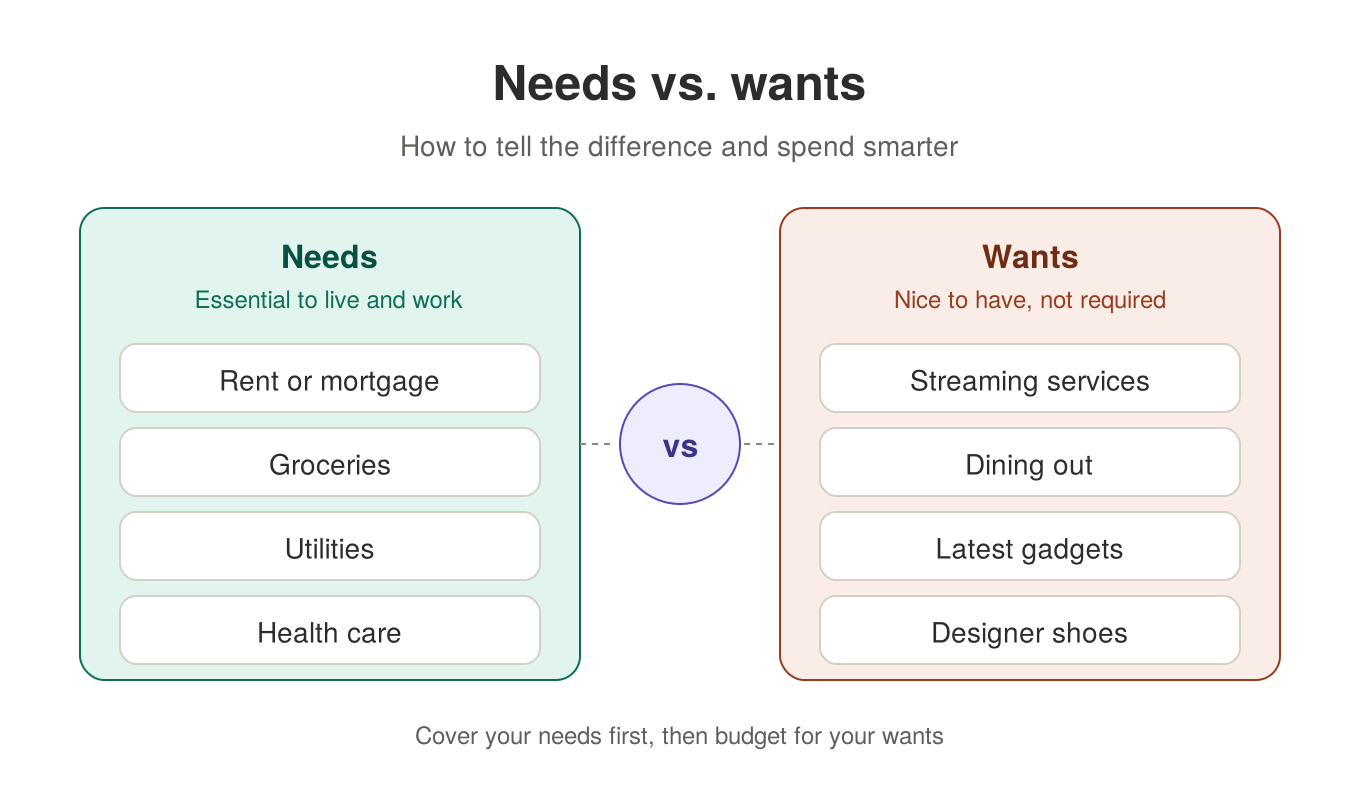
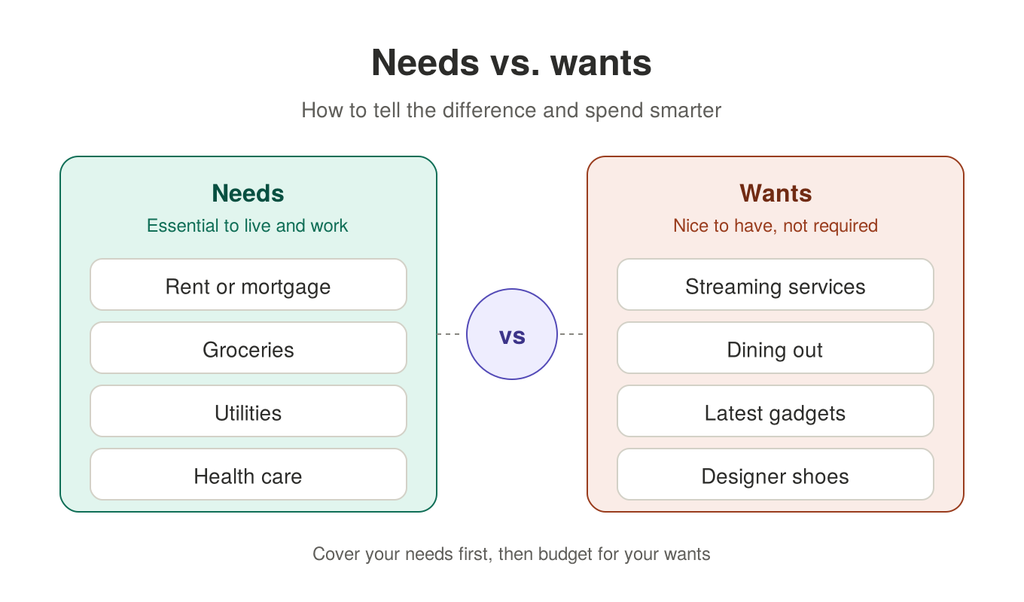
A need is something you must have to stay safe, healthy, housed, fed, and able to earn a living. A want is anything that adds comfort, status, or enjoyment but that you could live without, at least for now.
That sounds simple, yet real life blurs the line. A smartphone is a need if you freelance or run a small business online. Unlimited streaming data for football highlights all day? That’s probably a want.
Here is a quick comparison:
| Category | Typical Need | Typical Want |
|---|---|---|
| Food | Basic groceries and home-cooked meals | Daily restaurant lunches and delivery fees |
| Housing | Safe, affordable rent | Upgrading to a bigger flat for status |
| Transport | Getting to work or school reliably | Ride-hailing every trip when a bus works |
| Communication | Basic airtime and data | Premium plans you barely use |
| Clothing | Work-appropriate, durable clothes | Designer labels and constant new outfits |
| Health | Medicines, health cover, clinic visits | Cosmetic extras and luxury wellness |
Notice the pattern. Most needs have a “want-sized” version attached to them. Food is a need. Eating out every day is the want version of that need.
Why Confusing Needs vs Wants Quietly Drains Your Money
Almost nobody wrecks their finances with one dramatic purchase. The damage comes from small, repeated spending that feels harmless in the moment.
Say someone earns ₦300,000 a month and spends ₦3,000 a day on ride-hailing and snacks they call “essentials.” That’s roughly ₦90,000 a month, or 30 percent of their income. Yet the same person may struggle to save even ₦10,000.
Getting needs vs wants right matters even more when prices climb. When inflation rises, essentials take a bigger share of your pay, so there is less room for mistakes. Borrowing costs and prices are shaped by decisions at the central bank, and our guide to central bank interest rates explains how that works in plain language.
Credit makes the problem worse. Swiping a card or using a buy-now-pay-later app hides the pain of paying, so wants feel like needs. If you are unsure which tool suits you, our breakdown of credit cards vs debit cards will help.
7 Simple Tests to Separate Needs vs Wants
You don’t need all seven tests for every purchase. Pick the two or three that fit the moment.
1. Ask the Survival Question
Ask yourself: “Will my health, safety, housing, or income be at risk if I don’t buy this?” If the answer is yes, it’s a need. If the answer is “I’ll just feel a bit sad,” it’s a want.
2. Try the “Skip It for 30 Days” Test
Imagine going a month without the item. If life carries on normally, you’ve found a want. If something important breaks, such as your ability to get to work, it’s a need.
3. Look for a Cheaper Version
Real needs can usually be met in several ways. You need transport, but not necessarily a new car. You need a phone, but not necessarily the latest model. If a cheaper option solves the problem, the expensive upgrade is the want.
4. Use the 48-Hour Rule
For any non-essential purchase, wait two days before paying. Impulse fades fast. If you still want it after 48 hours and it fits your budget, buy it without guilt.
5. Convert the Price Into Work Hours
Divide the price by what you earn per hour. A ₦40,000 pair of shoes might equal a full week of effort for someone earning ₦1,000 an hour. Seen that way, many wants lose their shine.
6. Check How Often You’ll Use It
A needed item earns its place through repeated use. A treadmill used twice or a course never opened was never a need. Ask honestly, “How many times a month will this actually help me?”
7. Ask Who You’re Buying It For
Some of our biggest wants are really about impressing other people: the wedding outfit, the car, the party. There’s nothing wrong with enjoying life, but it helps to know whether you’re buying for yourself or for an audience.
The Gray Area: When a Want Disguises Itself as a Need
Honest needs vs wants decisions get tricky in the middle, where the same item can sit on both sides depending on your situation.
A useful idea is to think in levels. The basic version of something is the need. Every upgrade above that level is a want.
- Phone: A working phone is a need. A flagship model is a want.
- Data: Enough to work, study, and stay in touch is a need. Heavy streaming plans are a want.
- Transport: Reaching your workplace is a need. Choosing the most comfortable option every time is a want.
- Housing: A safe, decent home is a need. Extra rooms and prestige addresses are wants.
Context matters too. A laptop is a want for a casual browser, but it’s a need for a graphic designer. Your goals and your work decide where the line falls, so don’t borrow someone else’s definition.
How to Build a Budget Around Needs vs Wants
Once you’ve sorted needs vs wants on paper, a budget becomes much easier to follow. Here is a simple process:
- Write down your monthly income after tax. Use only money you can count on.
- List your fixed needs. Include rent, utilities, food, transport, school fees, and minimum debt payments.
- Set a ceiling for wants. Decide the amount in advance. Spending on wants isn’t the enemy. Unplanned spending on wants is.
- Pay yourself first. Move savings out the day you get paid, before the month’s temptations begin.
- Review weekly. A five-minute check keeps small leaks from becoming big ones.
Many people use the 50/30/20 rule as a starting point: about half of income for needs, 30 percent for wants, and 20 percent for savings and debt repayment. Investopedia has a helpful explainer on the 50/30/20 budget rule if you want the full picture.
Those percentages are a guide, not a law. If rent and food already take 70 percent of your pay, you’ll need to adjust. Our article on how to save money on a low income shows how to make progress even when the numbers are tight.
If you struggle to stick to limits, try the cash method. Our guide to envelope budgeting shows how physical or digital envelopes make your “wants” limit hard to ignore. The Consumer Financial Protection Bureau also offers free budgeting tools and worksheets that anyone can use.
Finally, give your savings a safe home. Keep them with a bank licensed by the Central Bank of Nigeria, and compare options in our guide to checking vs savings accounts.
Pros and Cons of Prioritizing Needs vs Wants
Like any money strategy, this one has strengths and limits.
Pros
- You see exactly where your money goes.
- It reduces impulse buying and shopping regret.
- It frees up money for savings and emergencies.
- It builds a habit that works at any income level.
Cons
- Being too strict can make budgeting feel joyless.
- The gray area takes honest self-reflection.
- Family and social pressure can make “wants” feel compulsory.
- It needs regular review as your income and life change.
The fix for the cons is simple: budget a small, guilt-free amount for wants every month. A plan that includes fun is a plan you’ll actually keep.
Common Needs vs Wants Mistakes to Avoid
Even people with good intentions fall into these traps:
- Labeling everything an “emergency.” If it wasn’t unexpected and necessary, it wasn’t one.
- Ignoring small, repeated spending. Daily snacks, subscriptions, and transfer fees add up fast.
- Treating debt payments as optional. Missed payments can damage your credit record. Our guide on how to build credit from scratch explains why consistent repayment matters.
- Comparing yourself to others. Their income, debts, and priorities are not yours.
- Skipping savings until “later.” Without a cushion, a single surprise bill turns a want into a loan.
Frequently Asked Questions
Is a phone a need or a want?
It depends on how you use it. A basic working phone is a need for most people, especially if you work or study online. A premium model chosen for status or features you won’t use is a want.
What is the 50/30/20 rule?
It’s a budgeting guideline that splits after-tax income into 50 percent needs, 30 percent wants, and 20 percent savings and debt repayment. It’s a starting point, and you can adjust the numbers to match your cost of living.
How do I stop impulse buying?
Use the 48-hour rule, unsubscribe from promotional emails, and avoid saving card details on shopping apps. Writing items on a “wish list” instead of buying immediately also helps.
Are savings a need or a want?
Think of savings as a need. An emergency fund protects you when life goes wrong, so it belongs in your essentials, not your extras.
How can I teach children the difference between needs vs wants?
Use everyday examples. Let them pick between two things at the shop, explain why you can only afford one, and give them a small allowance to manage. Children learn needs vs wants fastest through real choices.
What if my income is too low to have any wants?
Even then, plan a very small amount for enjoyment, such as ₦2,000 a month. A tiny, planned treat keeps you motivated. It also stops you from breaking the whole budget in frustration.
How often should I review my needs and wants list?
Review it monthly, and again whenever your income, rent, or family situation changes. What counts as a need today may become a want next year, and the reverse is also true.
Final Thoughts: Make Needs vs Wants a Habit
Knowing the difference between needs vs wants won’t make you rich overnight. It will give you control, and control is where wealth starts. Every time you pause before a purchase and ask the right question, you move a little closer to your goals.
Start small. Pick one test from this list and apply it to your next three purchases. Then write down your fixed needs, set a wants limit, and move something into savings the moment you’re paid.
Want to keep going? Read our guide on envelope budgeting next, and explore more Growwxritik articles to build your money confidence one step at a time.
Disclaimer: This article is for educational purposes only and is not personalized financial, legal, or investment advice. Consider speaking with a qualified professional before making major financial decisions.