
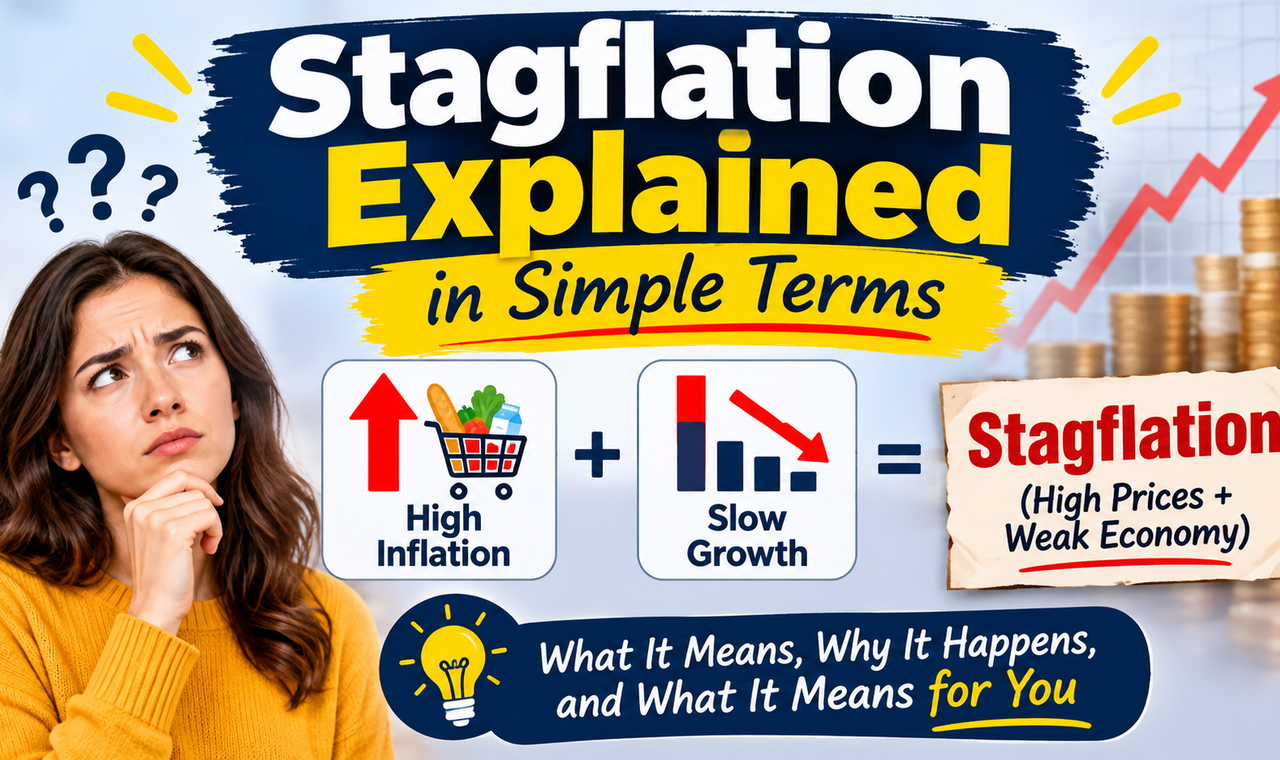
Imagine your grocery bill jumps, your boss freezes raises, and your friends start getting laid off. Everything costs more while the economy gets weaker. That uncomfortable mix has a name.
This is stagflation explained in plain English. You’ll learn what it means, what sets it off, how the US lived through it decades ago, and what everyday people can do to keep their finances steady.
Stagflation Explained: A Plain-English Definition
Stagflation combines “stagnation” and “inflation.” It describes an economy with sluggish or shrinking growth, high unemployment, and rising prices, all at once.
That’s strange because these forces usually move in opposite directions. In a slowdown, demand falls and price pressure cools. In a boom, jobs are plentiful but prices climb. Stagflation breaks the pattern, which is why it unsettles economists and households alike.
British politician Iain Macleod is widely credited with popularizing the word in the 1960s. For another take on the definition, see Investopedia’s stagflation guide.
So what is stagflation in one sentence? It’s prices rising while the economy and job market struggle.
7 Simple Facts: Stagflation Explained Quickly
- It pairs weak growth, high unemployment, and rising prices.
- It’s rarer than ordinary recessions or ordinary inflation.
- Supply shocks, especially energy shocks, are a classic trigger.
- The US faced it most famously in the 1970s.
- It’s hard to fix because the usual policy tools work against each other.
- Savers holding only cash and people on fixed incomes are hit hardest.
- Preparation, not prediction, is your best defense.
Stagflation Causes: What Sets It Off
Economists still argue about the exact recipe. Several ingredients show up again and again in the stagflation causes discussion.
Supply shocks. When a crucial input like oil suddenly becomes scarcer or costlier, businesses pay more and produce less. Prices rise while output and hiring fall.
Policy mistakes. Keeping money too easy for too long can feed inflation. Reacting too late, or sending mixed signals, can let it dig in.
Expectations. If households and companies expect prices to keep climbing, they behave accordingly. Workers ask for bigger raises. Businesses raise prices early. The expectation becomes self-fulfilling.
Supply chain breakdowns. Shipping bottlenecks, factory shutdowns, or labor shortages can lift prices and slow growth without any single dramatic shock.
These factors tend to stack. The combination, plus how policymakers respond, decides how long and how painful the episode becomes.
Stagflation in the 1970s: The US Case Study
The 1970s are the textbook example, so they’re worth walking through.
Inflation was already building in the early part of the decade. Then, in October 1973, an oil embargo by Arab members of OPEC sent energy prices soaring and created long lines at gas stations. The economy slid into a recession in 1974 and 1975, and unemployment climbed close to 9% in 1975. Prices kept rising anyway.
A second energy shock followed later in the decade. The Federal Reserve’s own history of the era, The Great Inflation, explains how price increases became deeply embedded, with inflation reaching double digits in 1979 and 1980.
The turning point came in 1979, when Paul Volcker took over as Fed chair. The Fed pushed interest rates up sharply, with the federal funds rate approaching 20% in 1981. Inflation finally broke, but the cost was steep. The early 1980s brought a deep recession, and unemployment rose above 10% in 1982.
The takeaway? Ending stagflation took years and real hardship. That’s why central banks work so hard to keep inflation expectations anchored before trouble starts.
Stagflation vs. Recession vs. Inflation
Many people lump these together. Here is the stagflation explained side by side.
| Condition | Price Pressure | Economic Growth | Job Market |
|---|---|---|---|
| Healthy inflation | Rising moderately | Positive | Often strong |
| Recession | Usually easing | Negative | Weakening |
| Stagflation | Rising | Weak or negative | Weak, high unemployment |
The dividing line is prices. A normal recession typically cools them. Stagflation doesn’t, and that’s what makes it so stubborn.
Why Is Stagflation So Hard to Fix?
The Federal Reserve has a dual mandate: maximum employment and stable prices. Usually those goals support each other. During stagflation they collide.
- Raise interest rates to fight inflation, and you risk deepening the slowdown and costing jobs.
- Cut interest rates to help growth and hiring, and you risk feeding inflation.
Neither path is painless. You can read how the Fed frames its price goal in its explanation of why it targets 2 percent inflation. Energy supply, trade, and government spending also matter, so solutions often reach beyond interest rates.
How Stagflation Hits Your Wallet
Here is the stagflation explained in everyday terms:
- Essentials cost more. Food, fuel, and housing eat a bigger share of each paycheck.
- Raises dry up. Employers cut back on hiring and pay increases.
- Cash loses power. Money sitting in a low-yield account buys less every year.
- Fixed incomes struggle. Retirees and others with set payments feel the squeeze first.
- Markets get bumpy. Slower growth and higher costs both pressure company profits.
The longer prices rise, the more purchasing power your savings lose. Our guide to the Rule of 72 shows how fast money doubles, and the same math helps you see how inflation shrinks it.
7 Smart Ways to Protect Against Stagflation
No one can time an economic cycle. You can still build a sturdier financial base. These are general ideas, not personal advice.
- Strengthen your emergency fund. Job losses rise when growth stalls. Keep several months of essential expenses in an insured account. A neobank or online bank may offer better savings rates than a traditional branch, but confirm FDIC coverage first.
- Trim the extras. Sorting spending into essentials and extras gets easier with our needs vs wants framework.
- Review your debt. Variable-rate balances, including many credit cards, can get pricier when rates rise.
- Look at inflation-linked government securities. Treasury Inflation-Protected Securities (TIPS) adjust their principal with inflation. Series I savings bonds also carry a rate partly tied to inflation, with purchase limits listed on TreasuryDirect.
- Diversify. No single asset reliably wins in stagflation. A mix can soften the blow from any one of them.
- Know your tolerance for swings. Volatile markets test nerves. Understanding your risk tolerance helps you avoid panicked decisions.
- Invest in your earning power. New skills, certifications, and professional connections protect your income when raises are scarce.
Common Mistakes to Avoid
- Assuming stagflation is guaranteed. Economists disagree about whether it will return. Prepare calmly instead of reacting to every headline.
- Parking everything in cash. Safety matters, but cash alone loses buying power when prices rise.
- Selling everything at the first scare. Dumping investments after a drop can lock in losses.
- Chasing a “sure thing” hedge. Gold, commodities, or crypto get pitched as foolproof. None are.
- Ignoring high-interest debt. It hurts more when budgets tighten.
- Mixing up stagflation and a regular recession. Stagflation explained correctly means recognizing that prices keep rising, which changes the playbook.
Frequently Asked Questions
What is stagflation in simple terms?
It’s when the economy is stuck or shrinking, unemployment is high, and prices keep rising anyway. The name blends stagnation and inflation.
What causes stagflation?
Common triggers include energy or other supply shocks, policy missteps, rising inflation expectations, and major supply chain problems. Usually several factors combine.
Has the US ever had stagflation?
Yes. The 1970s are the best-known example, featuring high inflation, weak growth, and elevated unemployment. The Federal Reserve’s history essay is a good place to dig deeper.
How is stagflation different from a recession?
A recession is a drop in economic activity that usually eases price pressure. Stagflation pairs weak growth with persistent inflation, which makes it harder to manage.
Which investments do well during stagflation?
There’s no guaranteed winner. Inflation-linked Treasury securities and diversified portfolios are often discussed, but results vary. A qualified professional can help you weigh options for your situation.
Is the economy in stagflation right now?
That depends on current data. Check the latest inflation numbers from the Bureau of Labor Statistics and compare them with growth and employment reports rather than leaning on headlines.
Final Thoughts
Stagflation explained simply: it’s a rare squeeze of weak growth, high unemployment, and rising prices. It’s tough to solve because the tools that help one problem can worsen the other.
You can’t control the economy, but you can control your response. Build your emergency fund, keep debt manageable, diversify, and keep growing your skills. Understanding stagflation explained clearly is the first step toward staying calm if conditions turn rough.
Pick one action this week, such as checking where your cash sits or reviewing your budget. Then explore more guides on Growwxritik to keep building your money confidence.
Disclaimer: This article is for educational purposes only and is not financial, legal, tax, or investment advice. Economic conditions change, and past events don’t predict future results. Consult a qualified professional about your own situation.
One thought