Most people Financial Goals don’t struggle with money because they’re careless. They struggle because their plan is a vague wish. “I want to save more” sounds nice, but it gives you nothing to measure and no date to hit.
Clear financial goals fix that. They turn a fuzzy hope into a number, a deadline, and a monthly action.
This guide shows you how to set financial goals using the SMART method, with examples you can copy. You’ll get a seven-step process, a set of sample goals, and the common mistakes to avoid.
What Are Financial Goals?
Financial goals are specific targets for your money, like building an emergency fund, paying off debt, or saving for a home. They connect what you earn and spend today to the life you want later.
They usually fall into three timeframes:
| Timeframe | Typical Length | Common Examples |
|---|---|---|
| Short-term | Under 1 year | Starter emergency fund, holiday spending, a small debt |
| Medium-term | 1 to 5 years | Home down payment, car purchase, paying off a loan |
| Long-term | 5+ years | Retirement, a child’s education |
Most people juggle all three at once. That’s normal. The trick is giving each goal its own plan.
What Does SMART Mean for Financial Goals?
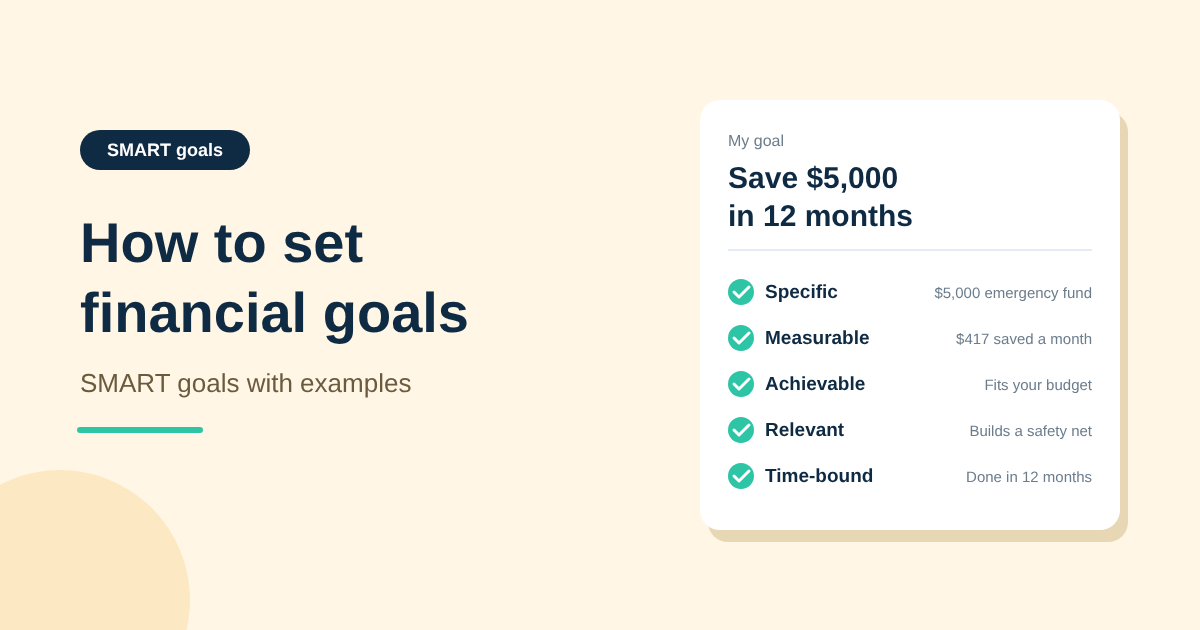
SMART is a simple checklist for turning an idea into a real target. Each letter filters out vagueness.
- Specific: What exactly do you want? Name the purpose.
- Measurable: What’s the dollar amount or number you’re tracking?
- Achievable: Can you realistically do it with your income?
- Relevant: Does it matter to your life right now?
- Time-bound: What’s the deadline?
Here’s the difference in action.
Vague: “Save more money.”
SMART: “Save $6,000 for an emergency fund by December 31 by moving $500 a month into a separate savings account.”
The second version tells you what to do, how much, and by when. You can’t say that about the first.
7 Simple Steps to Set Financial Goals
1. Start With Your Why
Money goals stick when they connect to something you care about. Maybe it’s less stress, more freedom, or a home of your own. Your financial goals should answer a real “why,” or you’ll quit when things get hard.
2. Take a Snapshot of Your Finances
You can’t plan a route without knowing your starting point. Write down your monthly income, regular expenses, debts, and savings. Be honest about where the money really goes.
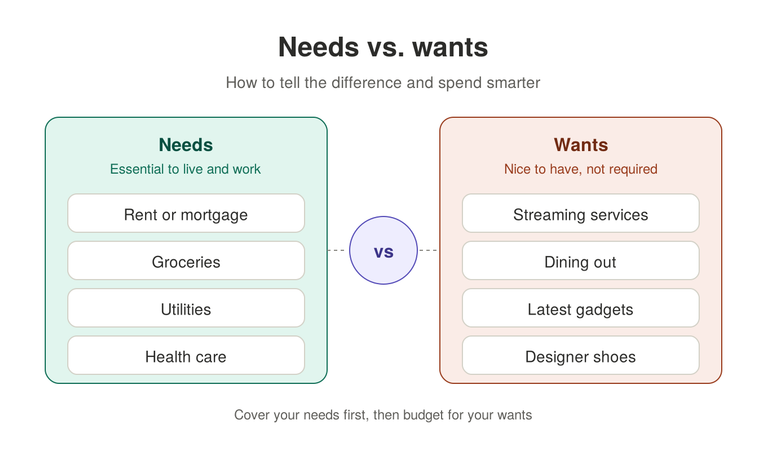
If your spending feels like a blur, sort it first. Our guide on needs vs wants makes this much easier, and it often reveals money you can redirect toward your goals.
3. Sort Goals by Timeline
List everything you want, then drop each item into short, medium, or long-term. This keeps you from treating a vacation fund and retirement as the same kind of problem.
4. Make Each Goal SMART
Run every goal through the five letters. If you can’t state the amount and the deadline, it isn’t ready yet.
5. Work the Math Backward
Divide the target by the number of months. That’s your monthly savings amount.
For example, say you want a $20,000 down payment in three years. That’s 36 months, so $20,000 ÷ 36 is about $556 a month. If that’s too steep, stretch the timeline or shrink the target. A realistic number you can keep beats an ambitious one you abandon.
6. Automate It
Set up an automatic transfer for the day after payday. When saving happens before you can spend the money, you don’t need willpower. Many online banks and neobanks let you create separate savings “buckets” for each goal, and our explainer on what a neobank is covers how they work.
7. Review Every Quarter
Life changes. Raises, job losses, and new expenses all shift the math. Every three months, review your financial goals, check your progress, and adjust the numbers if you need to. Adjusting a goal isn’t failing. It’s maintenance.
7 SMART Financial Goals Examples to Copy
These examples use hypothetical numbers. Swap in your own income, costs, and deadlines.
1. Build a Starter Emergency Fund
Goal: Save $6,000 by December 31 by transferring $500 a month into a dedicated savings account.
It’s specific, measurable, and tied to a clear need: covering surprise expenses without borrowing. Many experts suggest eventually saving three to six months of essential expenses, but a smaller starter fund is a strong first step. The CFPB offers a practical guide to building an emergency fund.
2. Pay Off a Credit Card
Goal: Clear a $3,600 balance in 12 months by paying about $300 a month, plus enough extra to cover interest.
High-interest debt is expensive. Paying it off is one of the most relevant goals you can set, because it frees up cash for everything else.
3. Save a Home Down Payment
Goal: Save $20,000 in 36 months by setting aside about $556 a month.
Keep the money in an FDIC-insured account so it’s protected if the bank fails. The FDIC explains how deposit insurance works on its site.
4. Capture Your Employer’s 401(k) Match
Goal: Raise your 401(k) contribution to 6% of pay by next December, increasing 1 percentage point every four months.
If your employer matches contributions, that match is part of your compensation. Plans differ, so check yours. The IRS has a helpful overview of 401(k) plans.
5. Pay Down Student Loans Faster
Goal: Add $100 a month to your student loan payment for the next 24 months, and confirm the extra goes toward principal.
Small extra payments can shave time and interest off a loan. Check with your servicer for how extra payments are applied.
6. Fund a Vacation Without Debt
Goal: Save $2,400 in 12 months by moving $200 a month into a travel fund.
Not every goal has to be serious. Planning fun spending means you can enjoy it without putting it on a credit card.
7. Start Long-Term Investing
Goal: Invest $300 a month for retirement for the next 25 years, and review it every year.
Long-term goals benefit from time. The Rule of 72 shows why. Money growing at a hypothetical 6% roughly doubles every 12 years (72 ÷ 6). Returns aren’t guaranteed, but the principle shows why starting early matters. You can test scenarios with the SEC’s compound interest calculator on Investor.gov.
Before choosing investments, figure out how much ups and downs you can handle. Our guide to risk tolerance can help.
How to Prioritize Your Financial Goals
You probably can’t fund everything at once. When your financial goals compete for the same dollars, a common order looks like this:
- Build a small starter emergency fund so surprises don’t become debt
- Capture any employer 401(k) match, since it’s extra compensation
- Tackle high-interest debt, like credit cards
- Grow your emergency fund toward a fuller cushion
- Fund medium- and long-term goals like a home or retirement
This isn’t a rule. Your situation may call for a different order, and a qualified professional can help you decide.
Common Mistakes When You Set Financial Goals
- Being vague. “Be better with money” can’t be measured.
- Setting too many goals. Three to five active goals is plenty for most people.
- Choosing unrealistic timelines. Saving $20,000 in six months on a modest income sets you up to quit.
- Skipping the emergency fund. Without one, one car repair can wreck your plan.
- Never tracking progress. What you don’t check, you drift away from.
- Quitting after one missed month. Everyone slips. Restart the next month.
- Ignoring inflation and rising costs. Update your targets when prices change.
FAQ: Financial Goals
How many financial goals should I have?
Three to five active goals is a manageable number for most people. More than that spreads your money and attention too thin.
What are good short-term financial goals?
Common ones include building a starter emergency fund, paying off a small debt, creating a monthly budget, or saving for a planned expense within the year.
How much should I save in an emergency fund?
Many experts suggest three to six months of essential expenses. If that feels huge, start with a smaller milestone, like one month, and build from there.
What if I miss a goal deadline?
Review why. If your income or expenses changed, adjust the deadline or monthly amount. A revised goal beats an abandoned one.
Should I pay off debt or save first?
For many people, a small emergency fund comes first, then high-interest debt. The best order depends on your interest rates, income stability, and comfort with risk.
How often should I review my goals?
Quarterly works well for most people. Also review after major life events, like a new job, a move, or a new family member.
Final Thoughts on Financial Goals
Setting financial goals isn’t about perfection. It’s about direction. A clear target, a monthly amount, and a deadline give your money a job, and that’s what moves you forward.
Here’s your next step. Pick one goal today. Write it in SMART form, do the backward math, and schedule the first automatic transfer. Then explore our guides on needs vs wants and risk tolerance to make the rest of your plan stronger.
Disclaimer: This article is for educational purposes only and is not personalized financial, investment, legal, or tax advice. All numbers are hypothetical examples, and investment returns are not guaranteed. Consult a qualified professional before making financial decisions.