
You’re about to sign for a loan, and the lender asks a simple question: Fixed vs Variable Rates It sounds like a small detail. It isn’t. Understanding fixed vs variable rates can change what you pay by thousands of dollars over the life of a mortgage, car loan, or student loan.
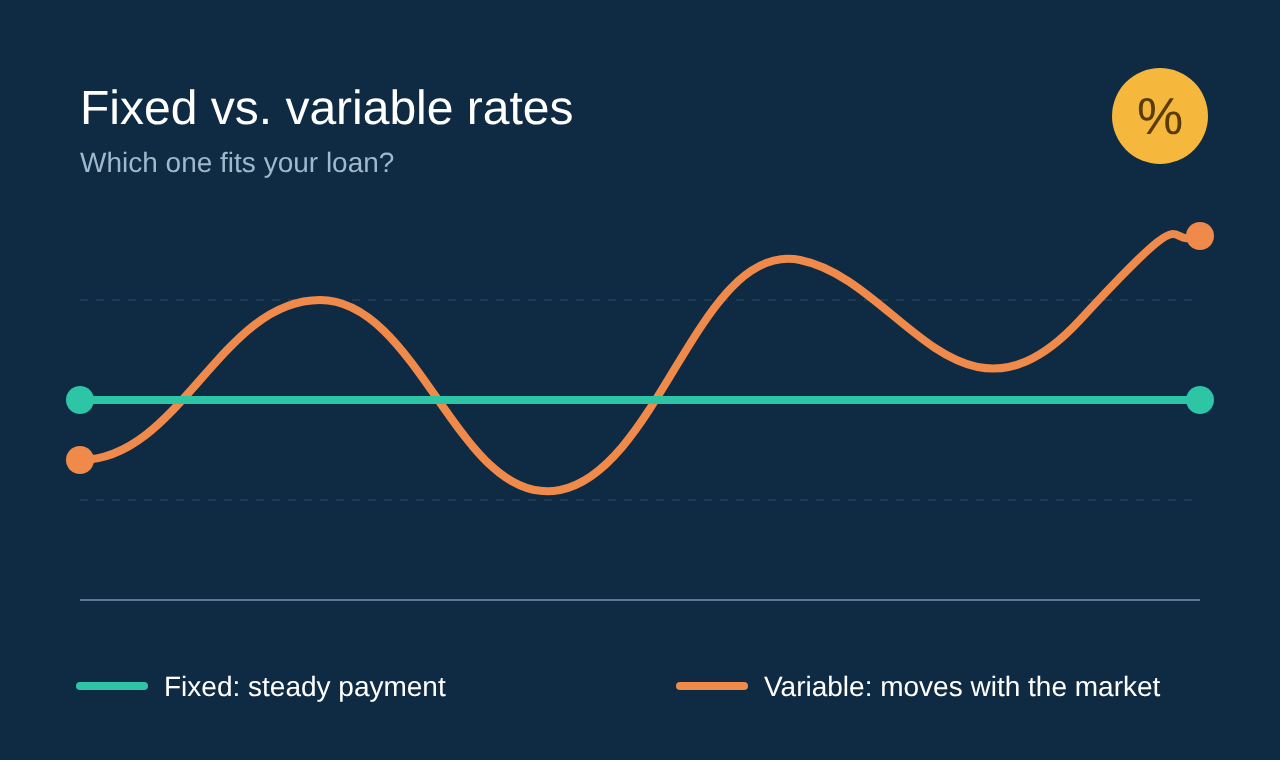
Here’s the short version. A fixed rate stays put. A variable rate moves. Which one is better depends on your budget, your timeline, and how much uncertainty you can live with.
In this guide to fixed vs variable rates, we’ll break down how each type works, compare them side by side, and walk through seven smart ways to choose.
What Are Fixed vs Variable Rates?
Every loan, credit card, and savings account carries an interest rate. The difference between fixed vs variable rates comes down to one question: can that number change after you sign?
Fixed Interest Rates
A fixed interest rate is locked in for a set period, often the entire loan term. Take a 30-year fixed mortgage at 6.5%. That’s your rate in year one and in year thirty. Your principal-and-interest payment never changes.
That predictability is the main selling point. Investopedia’s overview of the fixed interest rate covers the basics well if you want a deeper definition.
Variable Interest Rates
A variable interest rate (also called an adjustable or floating rate) can rise or fall over time. Lenders usually build it from two pieces: a benchmark index, such as the prime rate or SOFR, plus a margin the lender sets. When the index moves, your rate follows.
Benchmarks like the prime rate tend to move after the Federal Reserve changes its target for short-term rates. You can see how those decisions get made on the Federal Reserve’s page for the Federal Open Market Committee.
Some loans mix both worlds. An adjustable-rate mortgage (ARM) often starts with a fixed period, then adjusts. A 5/1 ARM, for example, holds its starting rate for five years and can adjust once a year after that. Most ARMs include caps that limit how much the rate can rise at each adjustment and over the life of the loan. The CFPB’s Owning a Home tools explain what to look for in these terms.
Fixed vs Variable Rates Side by Side
Here’s how the two stack up at a glance.
| Feature | Fixed Rate | Variable Rate |
|---|---|---|
| Rate changes | None during the fixed term | Yes, on a schedule or when the index moves |
| Starting rate | Often higher | Often lower (not guaranteed) |
| Payment predictability | High | Low to moderate |
| If market rates rise | You’re protected | You absorb the increase |
| If market rates fall | Only by refinancing | Your rate can drop automatically |
| Best suited for | Long-term borrowers, tight budgets | Short-term borrowers, flexible budgets |
Pros and Cons of Each Option
Every trade-off in fixed vs variable rates shows up in the lists below.
Fixed Rate Pros and Cons
Pros
- Your payment is stable, which makes budgeting easier
- No surprises if market rates climb
- Simple to understand and compare
Cons
- The starting rate is often higher than a variable offer
- If market rates fall, you can’t benefit unless you refinance
- Refinancing costs money and requires approval
Variable Rate Pros and Cons
Pros
- The starting rate is often lower
- Your rate can fall when benchmarks fall
- Can work well if you’ll pay off the loan quickly
Cons
- Your payment can rise, sometimes sharply
- Harder to budget long term
- Terms such as caps, margins, and adjustment dates can be complex
A Real-Dollar Example
Let’s use round numbers. Say you borrow $300,000 on a 30-year mortgage. At 6.5%, the principal-and-interest payment is roughly $1,896 a month. At 7.5%, it’s roughly $2,098. That’s about $200 more every month, or around $2,400 a year, from a single percentage point.
Now picture a variable-rate loan that starts at 6%, below the fixed offer. Early on, you come out ahead. But if the rate climbs to 8% after a few adjustments, you’re paying noticeably more than the fixed borrower. If rates fall instead, the fixed borrower wishes they’d waited.
(This example is simplified. Real adjustments recalculate your payment based on your remaining balance and term.)
The lesson: fixed vs variable rates is a trade between certainty and potential savings. You’re paying for peace of mind with one, and taking a gamble with the other.
7 Smart Ways to Choose Between Fixed vs Variable Rates
Use these seven checks before you commit.
1. Start With Your Timeline
When weighing fixed vs variable rates, ask how long you’ll actually keep the loan. If you plan to sell or pay it off in three years, a 5/1 ARM’s fixed window might cover your whole stay. If you’ll hold it for 30 years, a variable rate means decades of exposure.
2. Stress-Test Your Budget
Ask yourself: could I still make the payment if my rate rose by 2 or 3 percentage points? If the answer is no, a variable rate is probably too risky. Separating essentials from extras makes this easier, and our guide on needs vs wants shows how to build a budget with breathing room.
3. Know Your Risk Tolerance
Some people sleep fine with an uncertain payment. Others check rates every morning. Our breakdown of risk tolerance can help you figure out which camp you’re in before you sign.
4. Read the Caps and Adjustment Schedule
For any variable loan, get these details in writing: how long the starting rate lasts, how often it adjusts, the cap per adjustment, the lifetime cap, and which index and margin apply. A “capped” rate can still rise a lot.
5. Compare the Real Gap
A variable rate that’s only a quarter point below a fixed offer isn’t much of a discount for the risk you’re taking. When comparing fixed vs variable rates, look at the full cost, including fees, not just the headline number.
6. Don’t Bet on Predictions
Professional forecasters often miss on where rates are headed. “Rates will drop soon” is a hope, not a plan. Choose the option you can live with if you’re wrong.
7. Plan Your Exit
Fixed-rate borrowers can refinance if rates fall. Variable-rate borrowers can refinance into a fixed rate if rates rise. Either way, refinancing means closing costs, credit checks, and approval you can’t guarantee. Ask about prepayment penalties before you sign.
Which Loans Usually Use Fixed vs Variable Rates?
The product often decides the question for you. Here’s the typical pattern:
- Mortgages: Both are common. Fixed rates dominate, and ARMs appeal to shorter-term buyers.
- Auto loans: Usually fixed.
- Federal student loans: Fixed. Loans first disbursed on or after July 1, 2006 carry fixed rates.
- Private student loans: Either, depending on the lender.
- Credit cards: Typically variable, tied to the prime rate.
- Home equity lines of credit (HELOCs): Typically variable.
- Personal loans: Often fixed.
Credit cards deserve special attention. A high variable APR can compound fast, and the Rule of 72 shows how quickly. At a 24% rate, a balance can roughly double in three years if left untouched (72 ÷ 24 = 3).
The logic flips for savings. Online savings accounts usually pay variable APYs, so you want rates to rise. Many digital banks advertise them, and our explainer on what a neobank is covers how they work.
Common Fixed vs Variable Rates Mistakes
Avoid these traps:
- Choosing on the starting rate alone. A low introductory rate can reset higher.
- Ignoring the caps. A 5-point lifetime cap still allows a big increase.
- Assuming you’ll refinance later. Credit, home values, and market rates may not cooperate.
- Borrowing the maximum. A low initial variable payment can tempt you to take on more debt than you can handle.
- Skipping the fine print. Know the index, margin, floor, and adjustment dates.
- Forgetting fees. Origination, closing, and prepayment costs can erase a rate advantage.
FAQ: Fixed vs Variable Rates
Is a fixed or variable rate better?
Neither wins every time. A fixed rate suits borrowers who value stability and plan to keep the loan long term. A variable rate can suit those who can absorb payment swings or expect to repay quickly.
Can a variable rate go down?
Yes. If the benchmark index falls, your rate can fall too. Some loans include a floor, meaning a minimum rate below which yours can’t drop. Check your loan terms.
Is a fixed-rate mortgage or an ARM better for first-time buyers?
Many first-time buyers choose fixed rates for predictability, especially with tight budgets. An ARM may work if you expect to move or refinance within the fixed window, but that plan carries risk.
Do fixed rates ever change?
Your rate doesn’t change during the fixed term. But your total monthly housing payment can still move if property taxes or insurance, often collected in escrow, go up. And on hybrid loans, the fixed period eventually ends.
What happens to my credit card rate when the Fed raises rates?
Most credit cards have variable APRs tied to the prime rate, so your APR typically rises when the prime rate does. Your card agreement spells out exactly how and when.
Should I refinance if rates change?
It depends on the break-even point: how long it takes for monthly savings to cover closing costs. If you’ll move before that point, refinancing may not pay off.
Final Thoughts on Fixed vs Variable Rates
The fixed vs variable rates decision isn’t about finding the “right” answer. It’s about matching the loan to your timeline, your budget, and your comfort with uncertainty. Fixed rates buy you certainty. Variable rates offer possible savings and real risk.
Here’s your next step. Grab your latest loan offer and recalculate the payment at 2 to 3 points higher. If that number makes you wince, you have your answer. Then explore our guides on risk tolerance and needs vs wants to build a plan you can stick with.
Disclaimer: This article is for educational purposes only and is not personalized financial, legal, or tax advice. Loan terms and rates vary by lender and borrower. Consult a qualified financial professional before making borrowing decisions.