Your savings in Certificate of Deposit are sitting in a checking account, earning almost nothing. You don’t want to gamble the money in the stock market, but you’d like it to work a little harder. That’s where a certificate of deposit comes in.
A CD is one of the simplest ways to earn a fixed return on money you won’t need for a while. There’s no ticker to watch and no market to time.
This guide explains what a certificate of deposit is, how it works, what happens if you cash out early, and seven simple facts to know before you buy.
What Is a Certificate of Deposit?
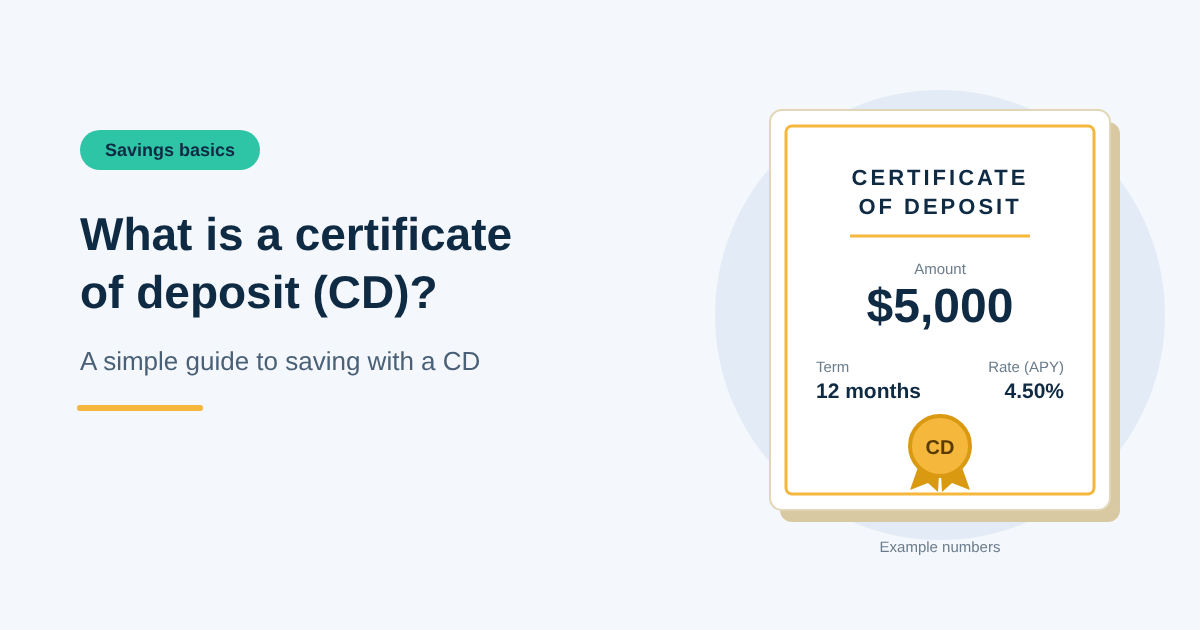
A certificate of deposit is a savings product offered by banks and credit unions. You agree to leave a set amount of money untouched for a fixed term, such as six months, one year, or five years. In return, the bank pays you interest, often at a higher rate than a regular savings account.
Think of it as a loan to the bank. You lend it your money for a set time, and it pays you for the privilege. When the term ends, called the maturity date, you get your original deposit back plus the interest you earned.
For a deeper definition, see Investopedia’s certificate of deposit guide.
How a Certificate of Deposit Works
The process is simple:
- Pick a term. Common terms run from a few months to five years.
- Make your deposit. Many CDs have a minimum, though amounts vary by institution.
- Lock in your rate. With a traditional CD, the rate stays fixed for the whole term.
- Wait. You earn interest while the money sits.
- Decide at maturity. You can withdraw the money, or roll it into a new CD.
Here are the key terms you’ll see:
- Principal: The amount you deposit.
- APY: The annual percentage yield, which includes the effect of compounding. Use it to compare CDs.
- Maturity date: The day the term ends.
- Early withdrawal penalty: A fee if you take money out before maturity.
- Grace period: A short window after maturity, often around a week or so, to withdraw or change your CD before it renews. This varies by institution.
A Simple Example
Say you put $10,000 into a three-year CD at a hypothetical 4% APY. After three years, you’d have about $11,249, which is roughly $1,249 in interest. You knew the number on day one, and that’s the appeal. Rates in this example are made up, and real offers change often.
Types of CDs
Not every certificate of deposit works the same way. Here are the common versions.
| Type | How It Works | Who It May Suit |
|---|---|---|
| Traditional | Fixed rate, fixed term, penalty for early withdrawal | Savers with a clear timeline |
| No-penalty | Lets you withdraw early without a penalty, often at a lower rate | People who want flexibility |
| Bump-up | Lets you raise your rate once or twice if the bank’s rates rise | Savers worried about rising rates |
| Step-up | Rate increases on a set schedule | Those who like built-in raises |
| Jumbo | Requires a large deposit, often $100,000 or more | Larger savers |
| Brokered | Bought through a brokerage firm rather than directly from a bank | Investors comparing many banks |
| IRA CD | A CD held inside an individual retirement account | Retirement savers seeking stability |
Terms and features differ by institution, so read the details before you commit.
Is a Certificate of Deposit Safe?
A certificate of deposit is among the lower-risk places to keep money, because the principal doesn’t swing with the stock market. Safety also comes from insurance.
CDs at FDIC-insured banks are covered up to $250,000 per depositor, per insured bank, per ownership category. Credit unions offer similar protection through the NCUA. The FDIC explains how deposit insurance works, including how to stay within the limits.
Many digital banks and fintech apps now offer CDs, often through a partner bank. Our explainer on what a neobank is covers how those arrangements work. Always confirm which institution actually holds your money and that it’s insured.
Low risk doesn’t mean no risk. Three things can still hurt you:
- Inflation risk: If prices rise faster than your CD’s rate, your money buys less over time.
- Opportunity cost: If market rates rise, you’re stuck with your lower rate until maturity.
- Liquidity risk: Your money is tied up, and getting it early costs you.
CDs vs. Savings Accounts vs. Money Market Accounts
How does a CD compare with other places to park cash?
| Feature | CD | High-Yield Savings | Money Market Account |
|---|---|---|---|
| Interest rate | Fixed for the term (traditional CDs) | Variable | Variable |
| Access to money | Penalty for early withdrawal | Flexible, within limits | Flexible, often with limits |
| Best for | Money with a known timeline | Emergency funds | Flexible cash with extra features |
| Insured? | Yes, if at an insured bank or credit union | Yes, if at an insured bank or credit union | Yes, if at an insured bank or credit union |
The trade-off is simple. A CD gives you a locked-in rate in exchange for less flexibility. A savings account gives you flexibility in exchange for a rate that can fall.
The Cost of Breaking a Certificate of Deposit Early
Here’s where CDs bite. Say you open a one-year CD with $10,000 at a hypothetical 4.5% APY. That earns about $450 over the year. The bank’s early withdrawal penalty is three months of interest, which is about $112.50.
If you withdraw after two months, you’ve earned only about $75. The penalty is bigger than your earnings, so the bank may take the difference from your principal. You’d walk away with less than you put in.
Penalties vary widely. Some banks charge more for longer terms, and some CDs have no penalty at all. Check the exact terms before you deposit.
Pros and Cons of a Certificate of Deposit
Pros
- Fixed rate on traditional CDs, so your return is predictable
- Insured up to the limits at FDIC or NCUA institutions
- No market swings to worry about
- Rates can beat regular savings accounts
- Removes the temptation to spend your savings
Cons
- Money is tied up until maturity
- Early withdrawal penalties
- Fixed rates may lag if market rates rise
- Returns may not keep pace with inflation
- Interest is taxable
- Auto-renewal can catch you off guard
Can a CD Ladder Help?
A CD ladder splits your money across CDs with different maturity dates. Say you have $10,000. You put $2,000 each into 1-year, 2-year, 3-year, 4-year, and 5-year CDs. Each year, one CD matures. You can use the cash or reinvest it into a new five-year CD.
The result is regular access to part of your money, plus the chance to capture new rates as they change. Longer terms don’t always pay more, though, so compare real offers before laddering.
7 Simple Facts to Know Before Buying a Certificate of Deposit
Run through these checks before you commit.
1. Match the Term to Your Timeline
Only lock up money you won’t need until maturity. Saving for a down payment in two years? A two-year CD lines up neatly. A five-year CD doesn’t.
2. Compare APY, Not Just the Rate
APY shows what you actually earn over a year, including compounding. Online banks and credit unions often pay more than big brick-and-mortar banks, but not always, so shop around.
3. Keep Your Emergency Fund Separate
A CD isn’t the right home for money you might need tomorrow. Sorting essentials from extras makes this easier, and our guide on needs vs wants can help you decide what’s truly spare cash.
4. Know the Penalty Before You Deposit
Ask exactly how the early withdrawal penalty is calculated, and whether it can touch your principal. Get it in writing.
5. Watch for Auto-Renewal
Many CDs renew automatically at maturity, sometimes at a lower rate. Mark the date on your calendar and use the grace period to decide.
6. Stay Within Insurance Limits
If you’re saving more than $250,000, spread it across institutions or ownership categories so it stays covered.
7. Compare Your Rate to Inflation
A fixed rate sounds safe, but inflation can erode it. The Rule of 72 gives you a quick benchmark: at a 4% return, money roughly doubles in 18 years (72 ÷ 4). If inflation runs higher than your rate, your purchasing power shrinks.
How CD Interest Is Taxed
Interest earned on a certificate of deposit is generally taxable as ordinary income in the year it’s earned or credited, not necessarily the year the CD matures. Your bank typically sends a Form 1099-INT if you earn $10 or more in interest.
The IRS explains how interest income works on its Topic 403 page. CDs held inside an IRA follow retirement account rules instead, so check with a tax professional if that applies to you.
Common Certificate of Deposit Mistakes
Avoid these traps:
- Locking up emergency money. Needing it early means penalties.
- Ignoring the penalty terms. Read them before you sign.
- Chasing the highest rate without checking insurance. Confirm FDIC or NCUA coverage.
- Missing the maturity date. A forgotten CD may roll over automatically.
- Putting everything in one long-term CD. A ladder adds flexibility.
- Forgetting about inflation. A safe rate can still lose ground.
- Overlooking taxes. Interest counts as income.
- Ignoring other options. A high-yield savings account may fit better if you need access.
FAQ: Certificate of Deposit
What is a certificate of deposit in simple terms?
It’s a savings product where you leave money with a bank or credit union for a set term. In return, you earn interest, and you get your deposit back at maturity.
Are CDs FDIC insured?
CDs at FDIC-insured banks are covered up to $250,000 per depositor, per insured bank, per ownership category. Credit union CDs are protected by the NCUA under a similar limit.
Can you lose money in a CD?
You can’t lose money to market swings, but you can lose some principal if an early withdrawal penalty exceeds the interest you’ve earned. You could also lose ground to inflation, or exceed insurance limits at one institution.
What happens when a CD matures?
You typically get a grace period to withdraw the money or move it elsewhere. If you do nothing, many banks automatically renew the CD into a new term at the current rate.
Is a CD better than a savings account?
Neither is always better. A CD offers a locked-in rate with less access. A savings account offers flexibility with a variable rate.
How much do I need to open a CD?
It depends on the institution. Some require a few hundred dollars or more, and some have no minimum. Compare before you open one.
Final Thoughts on Choosing a Certificate of Deposit
A certificate of deposit isn’t exciting, and that’s the point. It trades flexibility for a predictable return on money you can afford to set aside. For short-term goals and a low-stress approach, that can be a good fit.
Here’s your next step. Write down the money you won’t touch for the next year or more. Then compare APYs and penalty terms from at least three institutions. If you’re unsure how much risk and inflexibility you can handle, our breakdown of risk tolerance can help you decide.
Disclaimer: This article is for educational purposes only and is not personalized financial, investment, legal, or tax advice. All numbers are hypothetical examples. Rates, terms, penalties, and insurance rules vary by institution and change over time. Consult a qualified professional before making financial decisions.