
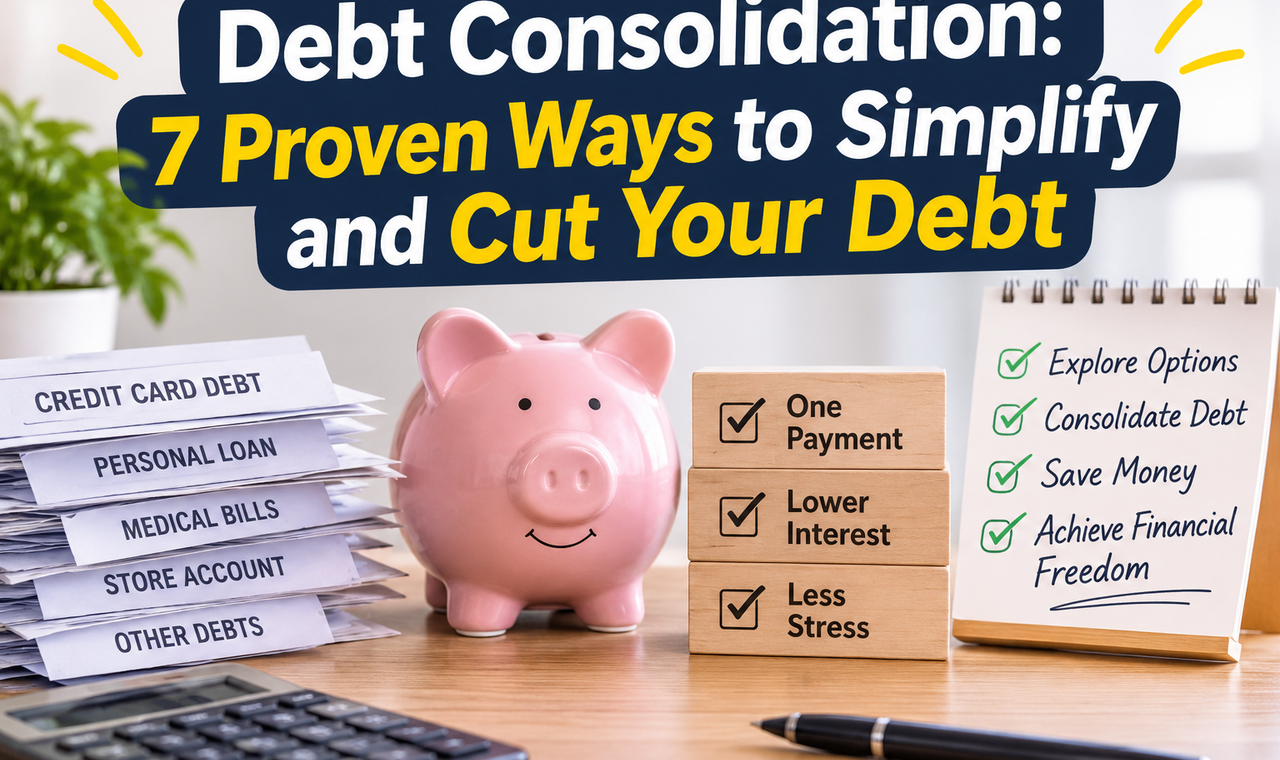
Debt Consolidation
If you’re juggling three credit cards, a store card, and a personal loan, you already know the headache. Different due dates, different interest rates, and a balance that never seems to shrink no matter how much you pay. It’s exhausting, and it’s expensive.
Debt consolidation is one of the most popular ways to fight back. The idea is simple: combine several debts into one, ideally with a lower interest rate and a single monthly payment. Done right, it can save you real money and give you a clear finish line. Done wrong, it can leave you deeper in debt than when you started.
This guide explains how debt consolidation works, the main ways to do it, what it costs, and seven smart things to know before you decide.
What Is Debt Consolidation?
Debt consolidation means taking out a new loan or credit product and using it to pay off multiple existing debts. You’re left with one new debt and one monthly payment instead of several.
It’s most commonly used for high-interest unsecured debt such as credit card balances, medical bills, and personal loans. The goal is to lower your overall interest cost, simplify your finances, or both.
One thing to be clear about from the start: debt consolidation doesn’t erase what you owe. It reorganizes it. The total only goes down if you pay it off, which is why the habits you build alongside it matter as much as the loan itself.
How Does Debt Consolidation Work?
The process follows the same basic steps no matter which method you choose:
- You list all your debts, with balances, interest rates, and minimum payments.
- You apply for a consolidation loan or balance transfer card.
- If approved, the new lender pays off your old accounts, or you use the funds to do it yourself.
- You make one monthly payment on the new debt until it’s gone.
The savings come from the interest rate. If your credit cards charge 24% and you consolidate at 12%, every dollar of debt costs you half as much to carry.
A Real-World Debt Consolidation Example
Say you owe $15,000 across several credit cards at an average rate of 24%, and you pay about $334 a month toward them.
At that pace, it would take nearly 10 years to clear the balance, and you’d pay well over $20,000 in interest. Now imagine you consolidate with a five-year personal loan at 12%. Your payment stays around $334 a month, but the loan is fully paid in five years, with roughly $5,000 in total interest.
Same monthly payment, half the time, and thousands of dollars saved. These numbers are illustrations, not guarantees, since your actual rate depends on your credit and the lender. But they show why debt consolidation can be so powerful when the rate drops meaningfully.
The Main Types of Debt Consolidation
1. Personal Consolidation Loans
A personal loan from a bank, credit union, or online lender gives you a lump sum at a fixed interest rate and a fixed repayment term, usually two to seven years. You use the money to pay off your other debts, then repay the loan in equal monthly installments.
This is the most common route for debt consolidation because the fixed payment and end date make planning easy. Rates depend heavily on your credit score and income.
2. Balance Transfer Credit Cards
Some credit cards offer a 0% introductory APR on transferred balances, often for 12 to 21 months. If you can pay off the debt within that window, you avoid interest almost entirely.
The catches are important. Most cards charge a balance transfer fee, commonly around 3% to 5% of the amount moved. And if you haven’t paid the balance by the time the promotional period ends, the regular rate, often high, kicks in. If you want to understand how card features differ, our breakdown of credit cards vs debit cards is a helpful starting point.
3. Home Equity Loans and HELOCs
If you own a home, you can borrow against your equity, usually at lower rates than unsecured debt. But there’s a serious trade-off: the loan is secured by your house. If you can’t repay, you could lose your home. Turning unsecured debt into secured debt is a big risk, so this option deserves extra caution.
4. 401(k) Loans
Some retirement plans let you borrow from your own balance. It’s convenient, but it comes with risks: you lose the investment growth on that money, and if you leave your job, the loan may become due quickly. Most experts treat this as a last resort.
5. Debt Management Plans
A debt management plan (DMP) is offered through nonprofit credit counseling agencies. The agency negotiates with your creditors for lower interest rates and rolls your payments into one monthly amount that you pay to the agency. It isn’t a new loan, but it achieves a similar result. The National Foundation for Credit Counseling is a well-known nonprofit network where you can find certified counselors.
7 Smart Things to Know Before Choosing Debt Consolidation
1. It Only Works If the New Rate Is Lower
The entire point of debt consolidation is to reduce what you pay. Compare the new loan’s APR, including fees, against the weighted average rate of your current debts. If it isn’t clearly lower, you’re only rearranging the pile.
2. Fees Can Eat Your Savings
Watch for origination fees on personal loans, which can run from 1% to 8% or more, and balance transfer fees on cards. Always calculate the total cost of the new debt, not just the monthly payment.
3. A Longer Term Can Cost More
A lower monthly payment feels like relief, but stretching your repayment over more years can mean paying more total interest, even at a lower rate. Choose the shortest term you can comfortably afford.
4. Your Credit Score Matters
Better credit means better rates. Applying for a loan triggers a hard inquiry, which can cause a small, temporary dip in your score. On the other hand, paying off credit cards lowers your credit utilization, which can raise your score over time. If your credit is still developing, our guide on how to build credit from scratch shows how to improve it before you apply.
5. It Doesn’t Fix the Spending Problem
This is the most important one. If the habits that created the debt don’t change, consolidation can backfire. People who clear their credit cards and then run them up again end up with the consolidation loan plus new card debt. Pair your plan with a real budget, such as the one in how envelope budgeting works.
6. Compare Several Offers
Use prequalification tools, which typically use a soft credit check that won’t affect your score. Compare at least three lenders on APR, fees, term, and monthly payment. Rates vary widely, and broader trends in central bank interest rates influence what lenders charge.
7. Beware of Scams and “Debt Relief” Promises
Be wary of companies that demand large upfront fees, guarantee they can erase your debt, or tell you to stop talking to your creditors. Legitimate nonprofit counselors don’t make those promises. The Consumer Financial Protection Bureau offers trustworthy guidance on credit cards and borrowing if you want to check your rights before signing anything.
When Does Debt Consolidation Make Sense?
Debt consolidation is usually a good idea when:
- You have multiple high-interest debts, especially credit cards
- Your credit is good enough to qualify for a meaningfully lower rate
- You have steady income and can afford the new monthly payment
- You’re committed to not adding new debt
- The total cost, including fees, is lower than what you’d pay now
When Does Debt Consolidation NOT Make Sense?
Think twice if:
- Your debt is small enough to pay off within a few months on your own
- You can’t qualify for a lower rate than you already have
- You’d need to put your home or retirement savings at risk
- Your spending habits haven’t changed
- The fees and longer term would cost more than your current plan
In some cases, a different strategy works better. The debt avalanche method (paying off the highest-interest debt first) or the debt snowball method (paying off the smallest balance first) can work well without any new loan. If your debt is overwhelming, nonprofit credit counseling or, in severe cases, speaking with a bankruptcy attorney may be more appropriate.
Debt Consolidation vs Debt Settlement
People often confuse these two, but they’re very different.
Debt consolidation means paying your debts in full with a new loan or plan. Your credit is generally affected only mildly.
Debt settlement means negotiating to pay less than you owe, often after you’ve stopped paying. It can seriously damage your credit, may trigger tax consequences, and often involves fees. It’s a much riskier path.
If you’re deciding between the two, consolidation is usually the safer option for anyone who can still make payments.
How Debt Consolidation Affects Your Credit Score
The impact is mixed, and it changes over time.
Short term: The hard inquiry and a new account can lower your score slightly.
Medium term: Lower credit card balances reduce your utilization, which usually helps your score. Consistent on-time payments help even more.
Long term: Paying off the loan on schedule builds a positive history. Closing old cards, however, can shorten your credit history, so consider keeping them open (with a zero balance) if they carry no annual fee.
How to Make Debt Consolidation Work
Stop using the cards you paid off. Put them away or freeze them so balances don’t creep back.
Automate your payment. Never miss a due date, since late payments hurt both your score and your wallet.
Build a small emergency fund. Without a cushion, a surprise expense sends you right back to the credit card. If your budget is tight, how to save money on a low income offers realistic starting points, and our guide to checking vs savings accounts helps you choose where to keep that cushion.
Pay extra when you can. Even small additional payments shorten the loan and cut interest. To see how quickly high-interest debt grows, try the rule of 72, which shows that debt at 24% can double in about three years if left alone.
For a neutral overview of the different options, Investopedia’s guide to debt consolidation is a helpful second reference.
Common Debt Consolidation Mistakes to Avoid
Running the cards back up. This is the number one reason consolidation fails.
Focusing only on the monthly payment. A smaller payment can hide a much larger total cost.
Skipping the fine print. Read about fees, prepayment penalties, and what happens when promotional rates end.
Using home equity carelessly. Don’t put your house on the line for credit card debt unless you fully understand the risk.
Choosing the first offer. A few minutes of comparison shopping can save hundreds or thousands of dollars.
Ignoring the root cause. Without a budget and a plan, the debt is likely to return.
Frequently Asked Questions
What is debt consolidation?
Debt consolidation is combining multiple debts into one new loan or payment, ideally with a lower interest rate, so you have a single monthly payment instead of several.
Does debt consolidation hurt your credit?
It can cause a small, temporary dip because of the credit inquiry and new account. Over time, lower utilization and on-time payments often improve your score.
What is the best way to consolidate debt?
It depends on your credit, the amount you owe, and your goals. Personal loans work well for many people, while balance transfer cards suit those who can pay off the balance during the 0% period.
Can I consolidate debt with bad credit?
It’s harder, and rates may be high. Options include a secured loan, a co-signer, or a debt management plan through a nonprofit credit counseling agency.
Is debt consolidation a good idea?
It can be, if you get a lower overall cost and commit to changing the habits that caused the debt. If the new rate isn’t lower, or you’ll keep overspending, it may not help.
What debts can you consolidate?
Commonly credit cards, medical bills, personal loans, and store cards. Federal student loans follow different rules, so look at federal options before consolidating them with a private lender.
How long does debt consolidation take?
Getting approved and funded can take a few days to a couple of weeks. Repaying the loan typically takes two to seven years, depending on the term.
Final Thoughts
Debt consolidation can be a smart tool: one payment, one rate, and one clear end date. But it’s a tool, not a cure. It works best when the new interest rate is meaningfully lower, the fees are small, and you’re committed to staying out of new debt.
Start by listing what you owe, compare offers from several lenders, and be honest about your spending habits. If debt consolidation fits your situation, it can turn a stressful tangle of bills into a manageable plan. If it doesn’t, there are other paths to explore. Either way, you’ve taken the first step toward getting out from under it.
This article is for educational purposes only and isn’t financial advice. Loan terms, rates, and fees vary by lender and individual circumstances. Consider speaking with a licensed financial professional or a nonprofit credit counselor about your situation