
Ask most people how long it would take to double $10,000 at 6% interest, and they’ll reach for a calculator, or give up. There’s a faster way, and you can do it in your head in about three seconds rule of 72
It’s called the rule of 72, and it’s one of the most useful mental shortcuts in personal finance. Investors, bankers, and financial planners have relied on it for generations because it turns a complicated compound interest problem into a simple division.
This guide explains how the rule of 72 works, how to use it with real examples, where it falls short, and seven smart ways to put it to work on your own money.
What Is the Rule of 72?
The rule of 72 is a quick way to estimate how many years it will take for an investment to double in value, based on a fixed annual rate of return.
The formula is simple:
Years to double = 72 ÷ annual interest rate
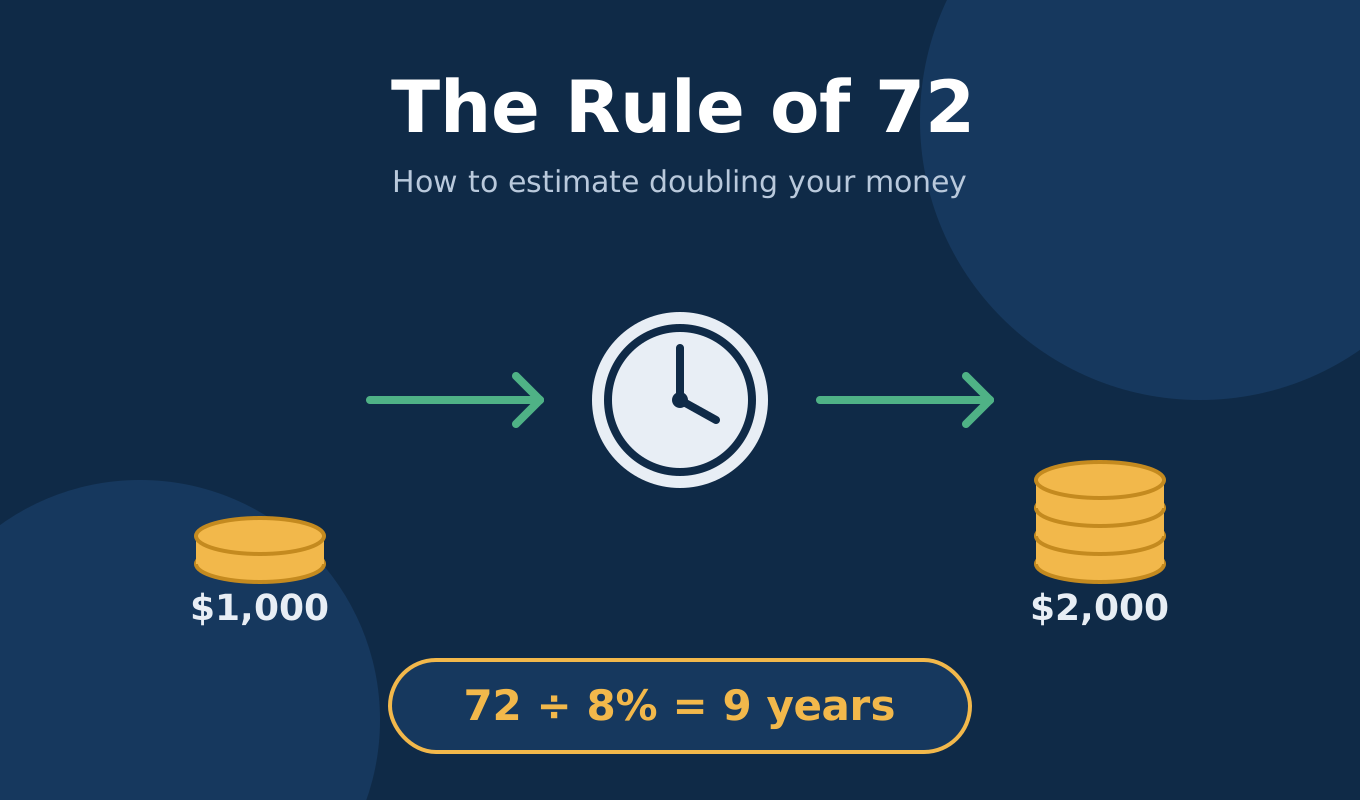
If your money earns 8% a year, divide 72 by 8. The answer is 9, so your money should double in roughly nine years. At 6%, it takes about 12 years. At 4%, about 18 years.
You use the whole number for the rate, not the decimal. So for 8%, you divide by 8, not 0.08.
Why Does the Rule of 72 Work?
The rule is a shortcut for compound interest, which is when you earn returns not just on your original money, but on the returns you’ve already earned. The exact math involves natural logarithms, but the rule of 72 approximates it neatly.
Why 72 specifically? It’s close to the result of the precise calculation for typical interest rates, and it divides evenly by many common numbers (2, 3, 4, 6, 8, 9, and 12), which makes mental math easy. Some people use 69 or 70 for higher accuracy at certain rates, but 72 is the favorite for everyday use.
Rule of 72 Examples You Can Try Right Now
Seeing the numbers makes the rule of 72 click.
| Annual Return | Years to Double (Rule of 72) |
|---|---|
| 2% | 36 years |
| 3% | 24 years |
| 4% | 18 years |
| 6% | 12 years |
| 8% | 9 years |
| 10% | 7.2 years |
| 12% | 6 years |
Example 1: A savings account. Suppose a high-yield savings account pays 4%. Dividing 72 by 4 gives 18 years to double your balance. That’s a useful reality check on how slowly low-rate savings grow.
Example 2: A stock market index fund. If you assume a long-term return of about 8%, which is an illustration and not a promise, your money would double roughly every nine years. A $10,000 investment could become $20,000 in nine years, $40,000 in 18, and $80,000 in 27.
Example 3: A 401(k). If you’re 30 and your retirement account averages 7%, the rule of 72 says it doubles about every 10 years. By 60, it could double three times, turning every dollar into about eight.
That last example shows the real power of compounding: time matters more than almost anything else.
Using the Rule of 72 in Reverse
You can also flip the formula to find the return you’d need:
Required rate of return = 72 ÷ years to double
Say you want to double your money in 10 years. Divide 72 by 10 and you get 7.2. You’d need an average annual return of about 7.2%.
This is a handy way to check whether a goal is realistic. If someone promises to double your money in two years, the rule of 72 says that requires a 36% annual return. That should make you pause, because returns that high are rare, and often a warning sign of a scam.
7 Smart Ways to Use the Rule of 72
1. Compare Savings Accounts and Investments
The rule of 72 makes differences in returns easy to see. At 1%, money takes 72 years to double. At 4%, it takes 18. Seeing that gap can motivate you to move cash out of a low-paying account. If you’re not sure where to keep your money, our guide to checking vs savings accounts explains your options.
2. Set Realistic Investment Goals
Before choosing an investment, use the rule of 72 to work out whether your timeline and target make sense. If you need your money to double in five years, you’d need about a 14.4% annual return, which means taking a lot of risk. Understanding your own comfort level is essential, as covered in how to find your investing comfort zone.
3. Understand the Cost of Waiting
Starting early is the biggest advantage an investor has. A 25-year-old earning 8% sees money double about four times by age 61. Someone who starts at 40 gets only about two and a half doublings by the same age. The rule of 72 shows exactly why waiting to invest costs so much.
4. See How Inflation Eats Your Money
The rule of 72 works for losses too. If inflation runs at 3% a year, the buying power of your cash is cut in half in about 24 years. At 6% inflation, it halves in just 12. Money sitting idle loses real value every year.
5. Realize How Debt Doubles Against You
The same math applies to what you owe. A credit card charging 24% interest, if left unpaid, can double your balance in about three years (72 ÷ 24). That’s a powerful reason to pay down high-interest debt quickly. Our comparison of credit cards vs debit cards shows how to use each wisely.
6. Judge the Impact of Fees
Investment fees reduce your return, which stretches the doubling time. If a fund earns 7% but charges a 1% fee, your net return is 6%, so doubling takes 12 years instead of about 10. A seemingly small fee can cost you years of growth. The SEC’s Investor.gov fee calculator helps you see the long-term impact.
7. Motivate Yourself to Save
Seeing how quickly money can grow is encouraging. If you’re working with a tight budget, even small amounts benefit from the same compounding. Practical steps are outlined in how to save money on a low income.
How Accurate Is the Rule of 72?
The rule of 72 is an estimate, not an exact answer. It works best for interest rates between about 6% and 10%. Outside that range, it drifts slightly.
For example, at 8%, the precise doubling time is about 9.01 years, almost identical to the rule’s answer of 9. At 20%, the rule says 3.6 years, while the exact figure is around 3.8. At very low rates like 1%, the rule says 72 years, while the exact answer is closer to 69.7.
For most personal finance decisions, the small difference doesn’t matter. If you need more precision, use a compound interest calculator. For a deeper look at the math, Investopedia’s guide to the rule of 72 breaks it down clearly.
Rule of 72 vs Rule of 70 vs Rule of 69
You may see similar rules mentioned.
Rule of 70: Often used for lower rates and for estimating economic growth, such as how long it takes a country’s output to double. It connects nicely to the ideas in what GDP is and why you should care.
Rule of 69.3: The most mathematically accurate for continuous compounding, but harder to calculate in your head.
Rule of 72: The best balance of accuracy and convenience for everyday annual compounding.
Limitations of the Rule of 72
Remember what the rule of 72 can’t do.
It assumes a steady return. Real investments rise and fall. Stocks don’t deliver exactly 8% every year, so the actual doubling time can be shorter or longer.
It ignores taxes. Taxes on gains or interest reduce your net return and lengthen the time to double.
It doesn’t account for inflation. Your money may double in dollars, but its buying power will grow less.
It doesn’t include new contributions. If you add money regularly, you’ll reach your goals faster than the rule suggests.
It’s not a guarantee. The rule of 72 is a planning tool, not a prediction. No investment return is promised.
How to Make the Rule of 72 Work for You
The rule of 72 is a reminder that growth comes from three things: rate, time, and consistency. You can influence all three.
Start now. Time is the most powerful ingredient. Even small amounts invested early can outgrow larger amounts invested late.
Keep costs low. Choose low-fee index funds and accounts to protect your return.
Spread your risk. A mix of investments helps smooth the ride, as explained in what diversification is and why it matters.
Keep your credit strong. Better credit means lower borrowing costs, so more of your money stays working for you. See how to build credit from scratch.
Budget consistently. Free up money to invest with a system like envelope budgeting.
Watch interest rates. Changes in central bank interest rates affect what savings accounts and bonds pay, which changes how fast your money doubles.
Frequently Asked Questions
What is the rule of 72?
The rule of 72 is a shortcut to estimate how many years it takes for money to double. Divide 72 by the annual rate of return to get the approximate number of years.
How do you calculate the rule of 72?
Divide 72 by your annual interest rate as a whole number. At 9%, for instance, 72 ÷ 9 equals 8 years.
Is the rule of 72 accurate?
It’s a good estimate, especially for rates between 6% and 10%. For very high or very low rates, the result can be slightly off, so use a compound interest calculator for precision.
Can the rule of 72 be used for debt?
Yes. It shows how long unpaid debt takes to double at a given interest rate, which is why high-interest credit card balances can grow so quickly.
Why is it called the rule of 72?
The number 72 closely approximates the math of compound interest for common rates, and it divides evenly by many numbers, making it easy to use mentally.
Does the rule of 72 work for inflation?
Yes. Divide 72 by the inflation rate to estimate how long it takes for prices to double, or for the buying power of your money to be cut in half.
What return do I need to double my money in 10 years?
Divide 72 by 10. You need roughly a 7.2% average annual return.
Final Thoughts
The rule of 72 won’t replace a financial planner or a compound interest calculator, but it gives you something just as valuable: instant perspective. In a few seconds, you can see how long your savings will take to grow, how quickly debt can spiral, and how much inflation quietly takes away.
Use the rule of 72 as a compass, not a map. Start early, keep costs low, stay consistent, and let compounding do the heavy lifting. Your future self will thank you for every year you let your money work.
This article is for educational purposes only and isn’t financial advice. Investment returns are not guaranteed, and examples are for illustration only. Consult a licensed financial professional about your own situation.
6 thoughts