

You’ve heard the word at family dinners, in the news, and all over social media. Maybe a cryptocurrency coworker swears by it. Maybe a friend lost money on it. So what is cryptocurrency, and should you care?
Here’s the plain-English answer. Cryptocurrency is digital money that lives on a computer network instead of inside a bank. There are no paper bills, no coins in your pocket, and no single authority running the show.
This guide explains what is cryptocurrency, how it works, and what risks come with it. You’ll also get seven simple things to know before you put a single dollar in. No hype, no jargon, no promises.
What Is Cryptocurrency?
Cryptocurrency is a digital asset designed to work as money or as a store of value. It uses cryptography, a form of advanced code, to secure transactions and control how new units are created.
Here’s the big difference from the dollars in your checking account. The US dollar is issued by the Federal Reserve and backed by the US government. Most cryptocurrencies have no central issuer at all. Instead, thousands of computers around the world keep the records together.
The first and best-known example is Bitcoin. It launched in 2009, created by a person or group using the name Satoshi Nakamoto. Since then, thousands of other coins and tokens have appeared. For a deeper definition, see Investopedia’s cryptocurrency overview.
How Cryptocurrency Works
To understand what is cryptocurrency at a practical level, you need three ideas: the blockchain, wallets, and the way transactions get verified.
The Blockchain: A Shared Digital Ledger
Picture a giant spreadsheet that thousands of people each keep a copy of. Every time someone sends crypto, a new line gets added. Lines are grouped into “blocks,” and the blocks are chained together in order. That’s a blockchain.
Because everyone holds a copy, changing an old entry would mean fooling the entire network. That’s what makes the record so hard to tamper with.
Wallets and Private Keys
A crypto wallet doesn’t hold coins the way a leather wallet holds cash. It holds your keys. A public address works like an account number you can share to receive funds. A private key works like a password that proves the funds are yours.
Here’s the catch. If you lose your private key, there’s usually no help desk to call. And if someone steals it, they can move your funds.
Mining and Staking
Someone has to confirm new transactions. Bitcoin uses “mining,” where computers compete to solve puzzles and earn new coins for validating transactions. Ethereum switched in 2022 to “staking,” where participants lock up coins to help validate transactions. Both are ways to keep the network honest without a bank in the middle.
Common Types of Cryptocurrency
Once you know what is cryptocurrency, it helps to know the main flavors. Not all crypto is the same.
| Type | What It Is | Example |
|---|---|---|
| Bitcoin | The first and largest cryptocurrency, often compared to “digital gold” | Bitcoin (BTC) |
| Smart contract platforms | Networks that run programs, not just payments | Ethereum (ETH) |
| Stablecoins | Tokens designed to track the value of the US dollar | USDC, Tether |
| Meme coins | Tokens driven mostly by internet hype | Dogecoin |
Bitcoin’s supply is capped at 21 million coins, which is part of why some people treat it as a scarce asset. Stablecoins aim for steady value, but they aren’t risk-free. A stablecoin can lose its dollar peg if the company behind it runs into trouble.
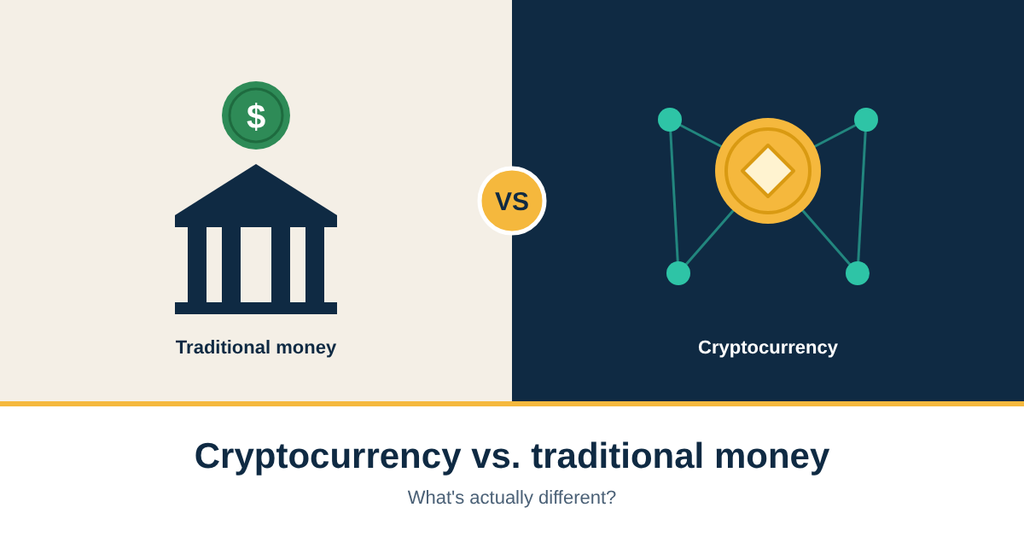
Cryptocurrency vs. Traditional Money
Part of understanding what is cryptocurrency is seeing how it differs from the money you already use. The differences matter more than the technology.
| Feature | Bank Deposits | Cryptocurrency |
|---|---|---|
| Issuer | Government and banking system | Usually a decentralized network |
| Deposit insurance | FDIC-insured up to legal limits | No FDIC insurance |
| Price stability | Relatively stable | Can swing sharply |
| Mistakes | Banks can often dispute or reverse errors | Transactions are often irreversible |
| Regulation | Extensive and long-established | Still evolving |
Many fintech apps now offer crypto features alongside everyday banking. If you use one, read the fine print. Our explainer on what a neobank is shows why a slick banking app and an insured bank aren’t always the same thing. The FDIC also explains how deposit insurance works, including what it does not cover.
What Is Cryptocurrency Used For?
People use crypto in a few main ways:
- Investing and speculation. This is the most common use in the US today. People buy hoping the price rises.
- Payments. Some merchants accept crypto, but everyday spending is still limited.
- Sending money across borders. Transfers can be fast, though fees and rules vary.
- Apps and contracts. Platforms like Ethereum run self-executing programs called smart contracts.
Notice that “replacing the dollar” isn’t on the list. For most Americans, crypto functions as a risky asset, not as everyday cash.
Pros and Cons of Cryptocurrency
Every honest answer to what is cryptocurrency includes both sides.
Pros
- Markets trade around the clock, every day of the year
- You can hold your own funds without a bank
- Transfers can move across borders quickly
- Some people see long-term growth potential
Cons
- Prices are highly volatile
- Scams and hacks are common
- No FDIC protection if a platform fails
- Mistakes are often permanent
- Taxes can get complicated
- Lost keys can mean lost money for good
A Simple Example of the Risk
Let’s use round numbers. You put $1,000 into a coin, and it falls 50%. You now have $500. To get back to $1,000, that coin has to rise 100%.
That’s just math, but it surprises people. And big drops aren’t rare. Bitcoin has had several declines of 50% or more in its history.
You may know the Rule of 72, a quick way to estimate how long steady growth takes to double your money. Crypto prices don’t move in a steady line, so shortcuts like that don’t fit well.
How Crypto Is Taxed in the US
Knowing what is cryptocurrency also means knowing the tax rules. The IRS treats digital assets as property, not as currency. That has real consequences.
Selling crypto for dollars, trading one coin for another, or spending it on goods can trigger a taxable gain or loss. Recent versions of Form 1040 also ask whether you received or disposed of digital assets during the year.
Keep records of what you paid, when you bought, and what you got when you sold. The IRS explains the rules on its digital assets page.
7 Simple Things to Know Before You Buy Crypto
Now that you understand what is cryptocurrency, here are seven checks to run before you spend anything.
1. Understand What You’re Buying
If you can’t explain a coin in two sentences, wait. Hype isn’t research.
2. Use Only Money You Can Afford to Lose
Rent, groceries, and your emergency fund are not crypto money. Separating essentials from extras is the first step, and our guide on needs vs wants shows how to do it.
3. Know Your Risk Tolerance
Could you watch a holding drop 50% without panic-selling? Our breakdown of risk tolerance can help you answer honestly.
4. Research the Platform
Before using an exchange or app, find out how it holds customer assets, what fees it charges, and what happens if it fails. Don’t rely on advertising or influencer posts.
5. Protect Your Accounts and Keys
Turn on two-factor authentication. Use strong, unique passwords. Never share your private key or recovery phrase with anyone, including someone claiming to be “support.”
6. Start Small
You don’t need to go all in. A small amount teaches you how buying, storing, and selling work, without a painful lesson.
7. Keep Records From Day One
Save transaction histories and receipts. Tax time is much easier when you’ve tracked everything as you go.
Common Cryptocurrency Mistakes
Beginners who learn what is cryptocurrency often trip over the same few things:
- Chasing hype. Buying because a coin is trending usually means buying after the jump.
- Falling for scams. Promises of guaranteed returns, fake giveaways, and impersonators are red flags.
- Investing the emergency fund. A volatile asset shouldn’t hold money you may need next month.
- Ignoring security. Reusing passwords or skipping two-factor authentication invites theft.
- Forgetting taxes. Trades and purchases can create taxable events.
- Believing “it can only go up.” No asset works that way.
FAQ: What Is Cryptocurrency?
What is cryptocurrency in simple terms?
It’s digital money secured by code and recorded on a shared network instead of a single bank’s private database.
Is cryptocurrency legal in the US?
Owning and trading it is generally legal. Rules from federal and state agencies are still evolving, so check current guidance before you act.
Is cryptocurrency safe?
The underlying technology can be secure, but the risks around it are real: price swings, scams, hacks, and platform failures. Safety depends largely on how you buy, store, and protect it.
Is crypto FDIC insured?
No. FDIC insurance covers deposits at insured banks, not cryptocurrency. If a crypto platform fails, you could lose your funds.
How much money do I need to start?
Many platforms let you buy small amounts, but minimums and fees vary. Start with an amount you can afford to lose entirely.
Do I have to pay taxes on crypto?
In many cases, yes. Selling, trading, or spending crypto can create a taxable gain or loss, and some income paid in crypto is taxable too.
Final Thoughts on What Is Cryptocurrency
So, what is cryptocurrency? It’s digital money built on shared technology, with real innovation behind it and real risk attached. It isn’t a guaranteed path to wealth, and it isn’t automatically a scam. It’s a volatile asset that rewards patience and punishes carelessness.
Here’s your next step. Before buying anything, write down why you want to own crypto and how much loss you could handle. If those answers are fuzzy, keep learning. Start with our guides on risk tolerance and needs vs wants, then build from there.
Disclaimer: This article is for educational purposes only and is not personalized financial, investment, legal, or tax advice. Cryptocurrency is highly volatile and you can lose some or all of your money. Consult a qualified professional before making financial decisions.