Most people open a bank account without thinking too hard about it. You walk in, sign some forms, and leave with a card. But the type of account you choose, and whether you have one or two, quietly shapes how easily you spend, how fast you save, and how much you pay in fees.
Understanding checking vs savings accounts is one of the first real steps toward financial control. They look similar on a banking app, yet they’re built for very different jobs. One is designed for moving money. The other is designed for keeping it.
In this guide, you’ll learn what each account does, how they differ in access, interest, fees, and limits, and how to decide which one you need. By the end, you’ll know exactly how to use both to make your money work harder.
What Is a Checking Account?
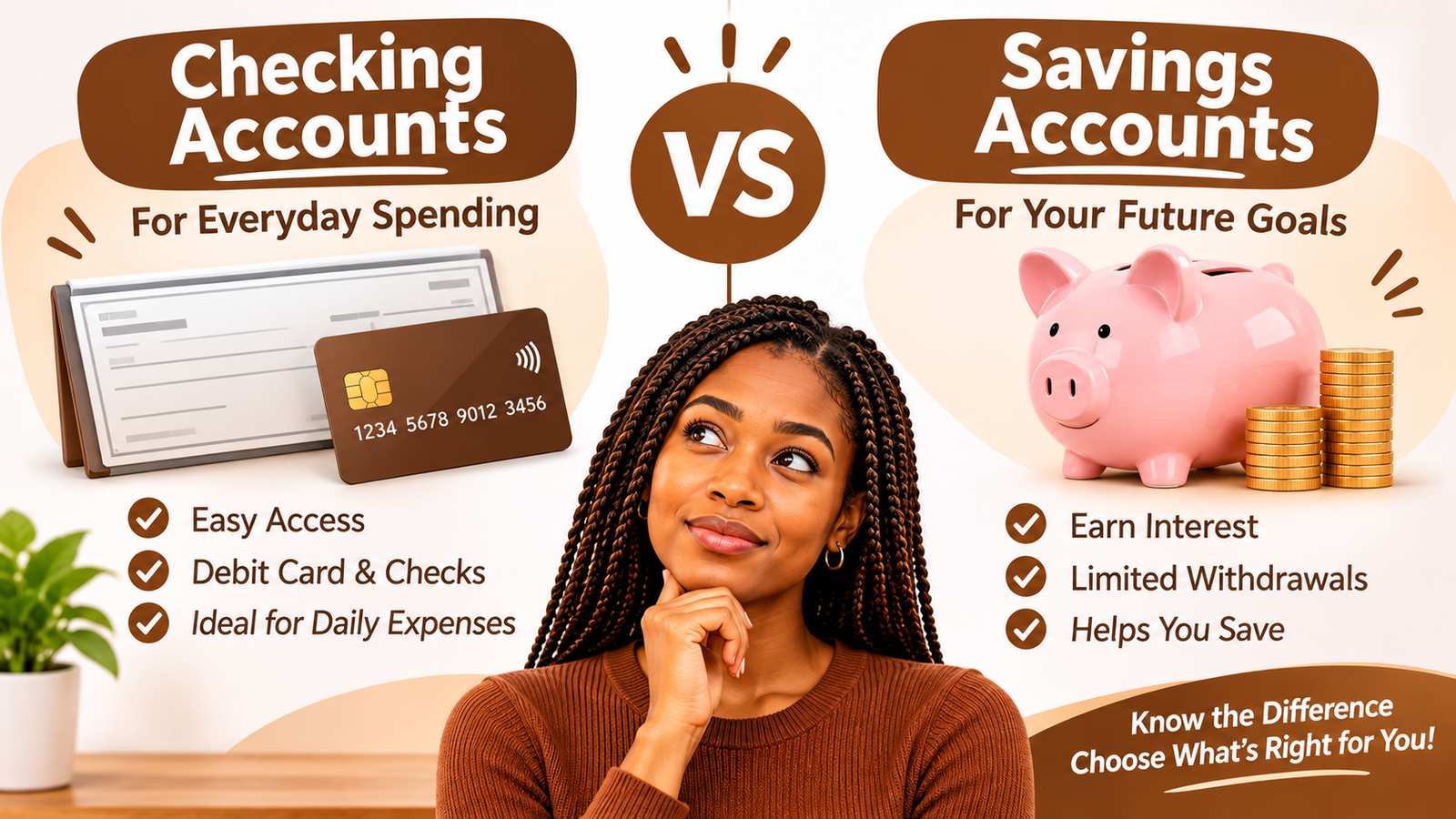
A checking account is your everyday spending account. It’s where your salary usually lands and where your bills, debit card purchases, and transfers come from.
Checking accounts are built for frequent use. You can deposit money, withdraw cash at ATMs, pay with a debit card, set up direct debits, write checks, and send transfers, all without worrying about how many times you do it each month.
The trade-off is that checking accounts typically pay little or no interest. Their job is convenience, not growth.
What Is a Savings Account?
A savings account is a place to store money you don’t plan to spend right away. It’s meant for goals: an emergency fund, a holiday, a wedding, a down payment, or simply a financial cushion.
Savings accounts usually pay interest, meaning the bank rewards you for leaving your money with them. Access is more limited by design. That small amount of friction is a feature, not a flaw, because it makes it harder to spend your savings on impulse.
Checking vs Savings Accounts: Key Differences at a Glance
| Feature | Checking Account | Savings Account |
|---|---|---|
| Main purpose | Daily spending and bill payments | Storing money and earning interest |
| Interest rate | Very low or none | Higher, varies by bank |
| Access to money | Unlimited, easy | Often limited |
| Debit card | Yes | Usually no |
| Withdrawal limits | Rarely | Sometimes monthly limits or fees |
| Monthly fees | Possible, often waivable | Possible, often waivable |
| Best for | Spending and bills | Goals and emergencies |
Let’s break down each difference.
1. Purpose
This is the simplest way to tell them apart. Checking is for money you’ll use soon. Savings is for money you’ll use later. When you give each account one clear job, it becomes much easier to manage your finances without confusion.
2. Access and Convenience
Checking accounts are designed for easy access. You get a debit card, online banking, mobile transfers, and often the ability to write checks or set up automatic payments.
Savings accounts are more restricted. Many don’t come with a debit card, and some banks limit the number of withdrawals or transfers you can make each month. In the United States, the old federal limit of six withdrawals per month was removed in 2020, but many banks still apply their own limits, so check your bank’s rules.
3. Interest Rates
Savings accounts almost always pay more interest than checking accounts. The gap can be small at traditional banks and much larger at online banks and credit unions, which often offer higher rates because they have lower overhead costs.
Two terms are worth knowing. APY (annual percentage yield) is the real rate of return you earn in a year, including compound interest. High-yield savings accounts are savings accounts that pay noticeably more than the national average, and they’re often worth the effort of switching.
Rates change with the economy, so compare current offers before choosing. The FDIC’s national rates page publishes average rates you can use as a benchmark.
4. Fees
Both account types can come with fees, though you can usually avoid them.
Checking accounts may charge monthly maintenance fees, overdraft fees, out-of-network ATM fees, and foreign transaction fees. Savings accounts may charge monthly fees if your balance falls below a minimum, or fees for excess withdrawals.
Many banks waive these charges if you keep a minimum balance or set up direct deposit. Always read the fee schedule before opening an account, and choose one with low or no monthly fees whenever possible. The Consumer Financial Protection Bureau’s guide to bank accounts explains what to look for.
5. Minimum Balance Requirements
Some checking and savings accounts require a minimum balance to avoid fees or to earn the advertised interest rate. This is more common with savings accounts, especially high-yield ones. If you can’t comfortably maintain the minimum, look for accounts with no minimum requirement.
6. Safety and Insurance
Both account types are very safe at properly licensed institutions. In the United States, deposits at FDIC-insured banks are protected up to $250,000 per depositor, per bank, per ownership category. Credit union accounts get similar protection through the NCUA. Other countries have their own deposit insurance schemes, so check what applies where you live.
In practical terms, your money is protected in both account types if the bank fails, as long as you stay within the insured limit.
Pros and Cons of Checking Accounts
Pros
- Instant, unlimited access to your money
- Debit card, bill pay, and direct deposit
- Easy to manage day-to-day spending
- Widely accepted and widely available
Cons
- Little or no interest
- Overdraft and maintenance fees can add up
- Easy to overspend since money is always within reach
Pros and Cons of Savings Accounts
Pros
- Earns interest on your balance
- Separates your savings from spending money
- Safe and insured
- Builds the habit of saving
Cons
- Limited access and possible withdrawal limits
- Interest rates may not keep up with inflation
- Some accounts require minimum balances
Do You Need Both Accounts?
For most people, yes. Using both gives your money a clear structure. Your checking account handles income and spending. Your savings account holds money for goals and emergencies.
Keeping them separate also protects you from yourself. If your emergency fund sits in the same account as your daily spending money, it’s easy to dip into it without noticing. A separate savings account creates a small barrier that keeps your safety net intact.
[INTERNAL LINK: add a link here to your Growwxritik post on building an emergency fund]
How Much Should You Keep in Each Account?
There’s no perfect formula, but these guidelines work well for most people:
Checking: Keep enough to cover one month of expenses, plus a small buffer so you don’t trigger overdraft fees. Anything beyond that is probably sitting idle and could be earning interest elsewhere.
Savings: Aim to build an emergency fund covering three to six months of essential expenses. After that, you can add separate savings for specific goals like travel, a car, or a home.
If your checking balance regularly sits far above what you need, move the extra into savings.
How to Use Checking and Savings Accounts Together
A few simple habits make the pair work much better:
Automate your savings. Set up a recurring transfer from checking to savings right after payday. When saving happens automatically, you don’t rely on willpower.
Pay yourself first. Treat savings like a bill. Move the money before you start spending the rest.
Name your savings accounts. Many banks let you open several savings accounts or label them, such as “Emergency Fund” or “Holiday.” Giving money a purpose makes you less likely to spend it.
Review your accounts quarterly. Check your fees, balances, and interest rates a few times a year to make sure you’re not overpaying or under-earning.
Link the accounts. Linking your checking and savings can make transfers instant and may help you avoid overdraft fees by pulling from savings when needed. Just check whether your bank charges for this.
If you already use a system like [INTERNAL LINK: add a link here to your Growwxritik post on envelope budgeting], your checking account funds your spending categories while savings covers everything else.
Common Mistakes to Avoid
Keeping all your money in checking. You miss out on interest and make it easier to overspend.
Ignoring fees. A monthly maintenance fee of $12 costs you $144 a year. That’s money you could be saving.
Leaving savings in a low-rate account. If your bank pays very little, switching to a high-yield account can earn you meaningfully more for the same deposit. For a simple explanation of how interest compounds, Investopedia’s overview of savings accounts is a useful reference.
Using savings for everyday spending. Once savings becomes a second spending account, it stops doing its job.
Not tracking minimum balances. Dropping below a required minimum can trigger fees or reduce your interest rate.
Frequently Asked Questions
What is the main difference between checking vs savings accounts?
A checking account is for daily spending and bill payments, while a savings account is for storing money and earning interest. Checking offers easy access, and savings offers higher interest with more limited access.
Can I have a checking and savings account at the same time?
Yes, and most financial experts recommend it. Many banks let you link both so you can move money between them easily.
Which account earns more interest?
Savings accounts, especially high-yield savings accounts from online banks, almost always pay more than checking accounts.
Is my money safe in a savings account?
Yes, as long as the bank is insured. In the U.S., FDIC insurance covers up to $250,000 per depositor, per bank, per ownership category.
How many savings accounts should I have?
There’s no limit. Many people keep one for emergencies and separate accounts for specific goals, which makes progress easier to see.
Final Thoughts
The difference between checking vs savings accounts comes down to purpose. Checking is built for spending, with easy access and little interest. Savings is built for keeping, with higher interest and a little friction that protects your money.
You don’t have to choose one over the other. The strongest setup uses both: let your paycheck land in checking, automatically move a portion into savings, and give each account a clear job. Small habits like these, repeated month after month, are what turn a paycheck into real financial security.
This article is for educational purposes only and isn’t financial advice. Account terms, rates, and insurance rules vary by bank and country, so check with your provider.
Leave a Reply